💵
Value My Car → We Buy Cars — Even If You Don’t Buy From Us.
Get a real offer on your vehicle in minutes. No obligation, no pressure.




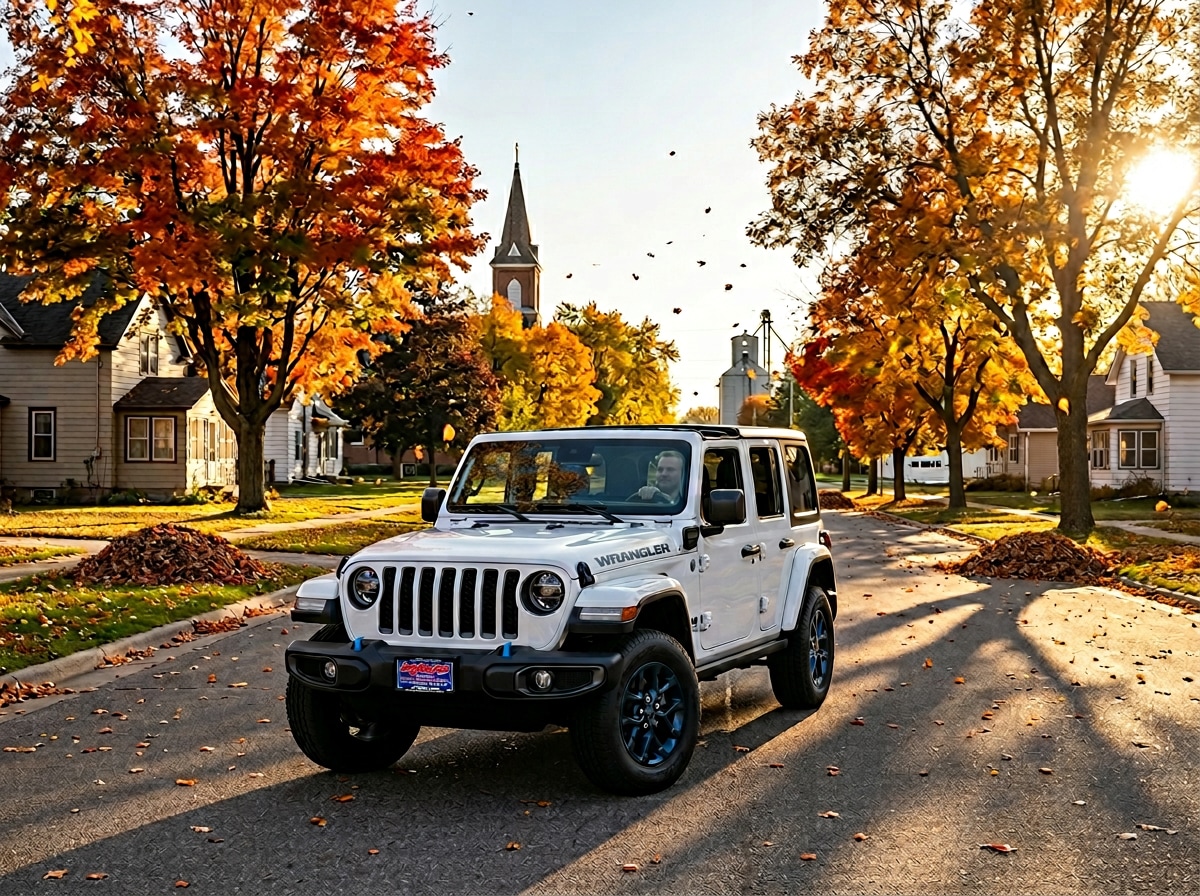
Engine choice on the 2026 Jeep Wrangler is more nuanced than it looks at first glance — and there are a few decisions within the engine choice that affect things you would not expect, like which 4WD system you get, whether remote start is available, and whether you can row your own gears. The Wrangler offers three engines across the lineup: a 2.0L turbocharged four-cylinder, a 3.6L V6, and the exclusive 6.4L V8 SRT® HEMI® in the Moab 392. This guide breaks down each one honestly so you can make the right call for how you actually drive. For the full 2026 Wrangler overview, see our 2026 Jeep Wrangler Buyer’s Guide. For trim-level context, see our 2026 Jeep Wrangler Trim Levels guide.
Quick Answer
The 2026 Jeep Wrangler offers three engines: a 2.0L turbo I4 (270 hp / 295 lb-ft), a 3.6L Pentastar® V6 (285 hp / 260 lb-ft), and a 6.4L SRT® HEMI® V8 (470 hp / 470 lb-ft, exclusive to the Moab 392). The 6-speed manual transmission is available only with the V6 on Sport and Rubicon trims. All three engines pair with an 8-speed automatic.
In This Guide
The 2026 Wrangler offers three engine options. The 2.0L turbo and the 3.6L V6 are available across most of the trim lineup. The 6.4L V8 SRT® HEMI® is exclusive to the Moab 392, which replaces the previous Rubicon 392 nameplate that Jeep retired after the 2025 model year.
| Engine | Output | Transmission |
|---|---|---|
| 2.0L I4 Turbo | 270 hp / 295 lb-ft | 8-speed automatic only |
| 3.6L Pentastar® V6 | 285 hp / 260 lb-ft | 6-speed manual or 8-speed automatic |
| 6.4L SRT® HEMI® V8 | 470 hp / 470 lb-ft | 8-speed automatic only (Moab 392 only) |
The 2.0L turbocharged inline-four (270 hp, 295 lb-ft) is the standard engine on the Sahara and delivers a modern turbocharged driving experience that feels strong in everyday use. It is available with the 8-speed automatic only — there is no manual transmission option with the 2.0T. The engine includes stop-start technology to help with fuel efficiency in city driving.
The turbocharged engine produces its peak torque (295 lb-ft) lower in the rev range than the V6, which gives it a responsive feel in daily driving — acceleration from a stop, merging on the highway, and low-speed off-road throttle modulation all feel confident. For buyers who spend most of their time on pavement and want a modern engine with good fuel efficiency, the 2.0T is a strong choice.
One practical note for Minnesota buyers: the 2.0T is automatic only, which means remote start is available — a meaningful advantage on cold January mornings in Hutchinson. If remote start matters to you, the 2.0T guarantees it is available. With the V6, remote start depends on whether you choose the automatic or manual transmission.
The 2.0T is right for you if: you want the Sahara’s standard engine, you prioritize fuel efficiency and a responsive turbocharged feel, you want automatic only, and remote start is important to you.
The 3.6L Pentastar® V6 (285 hp, 260 lb-ft) is the most versatile engine in the Wrangler lineup — and for most buyers, it is the engine we end up talking about most. Here is why it stays popular:
It is the only engine available with the 6-speed manual transmission. If you want to row your own gears in a Wrangler, the V6 is your only option. The 6-speed manual is available on the Sport and Rubicon trims in both 2-door and 4-door body styles. For buyers who genuinely enjoy driving and want that connection between engine and transmission, the V6 manual combination is one of the more engaging experiences in the full-size off-road SUV segment.
It is a proven, naturally aspirated engine. The Pentastar® V6 has been in the Jeep lineup for years and has a long track record of reliability. For buyers who do a lot of towing, plan to modify the Wrangler significantly, or simply prefer a naturally aspirated engine over a turbocharged one, the V6 is the trusted choice.
It is available across most of the trim lineup. The V6 is available on the same trims as the 2.0T — giving you maximum powertrain flexibility. On the Sahara, where the 2.0T is the standard engine, the V6 is available as an upgrade. The V6 also includes stop-start technology as standard. When paired with the 8-speed automatic on the Rubicon, it triggers the Rock-Trac® full-time 4WD system — the same as the 2.0T with the automatic.
“For most everyday buyers, the 3.6L V6 with the 8-speed automatic is the most balanced choice in the Wrangler lineup. It is proven, reliable, strong enough for towing and off-road use, and the automatic gives you remote start — which matters in a Minnesota winter.”
— Jordan Malone-Forst, Assistant General Manager
The V6 is right for you if: you want the manual transmission option, you prefer a naturally aspirated engine with a proven track record, or you are buying a Sport or Rubicon and want maximum powertrain flexibility.
This is one of the most personal decisions in the Wrangler buying process — and there is no universally right answer. But there are real trade-offs that matter for everyday buyers in central Minnesota.
| Category | 6-Speed Manual | 8-Speed Automatic |
|---|---|---|
| Engine availability | V6 only | 2.0T, V6, or V8 (Moab 392) |
| Remote start | Not available | Available |
| Adaptive Cruise Control | Not included | Included on Sport and Rubicon |
| Selec-Speed® Control (Rubicon) | Not included | Included on Rubicon |
| Rock-Trac® type (Rubicon) | Part-time 4:1 | Full-time 4:1 |
| Driving engagement | High — full driver control | Convenient — better for daily commuting and stop-and-go |
The most practical consideration for Minnesota buyers is remote start. If you park outside and want to warm the Wrangler up before heading out on a cold morning, remote start requires the automatic transmission. That alone steers most buyers toward the 8-speed auto in this region.
The other consideration worth knowing: on the Rubicon specifically, the 8-speed automatic changes the Rock-Trac® system from part-time to full-time — meaning you can leave it in 4WD on dry pavement without damaging the drivetrain. The manual gives you the part-time system only. For buyers who want the most capable daily Rubicon, the automatic is the stronger choice.
That said — if you genuinely enjoy driving a manual, the V6 six-speed combination in a Wrangler is a legitimately fun experience. It is a rare thing in today’s market and worth considering if it matters to you and remote start does not.
The 6.4L V8 SRT® HEMI® in the Wrangler Moab 392 (470 hp, 470 lb-ft) is a completely different conversation from the other two engines. It is exclusive to the Moab 392 — 4-door only — and pairs with an 8-speed automatic transmission engineered to handle the higher output of the V8. It is the most powerful engine ever offered in a Wrangler and it transforms the driving experience in a way that is immediately obvious.
The Moab 392 also comes with features that are not available on any other Wrangler engine configuration: Active Noise Control System, Enhanced Adaptive Cruise Control, a sport steering wheel with paddle shifters, steering wheel-mounted shift control, and a performance suspension tuned specifically for V8 power. The Moab 392 is also calibrated for higher top-end performance than the V6 and 2.0T.
The honest reality: the Moab 392 is for a specific buyer who wants V8 character, V8 sound, and V8 performance in an off-road SUV. Fuel efficiency is not the priority here. If you are considering the Moab 392 seriously, you likely already know what you want — and there is nothing else in the Wrangler lineup that replicates that experience.
The 6.4L V8 is right for you if: you are buying the Moab 392, you want maximum performance, and budget is not the constraint.
This is the part of the engine decision that catches a lot of buyers off guard — the engine and transmission you choose affects more than just how the Wrangler drives. Here is a summary of the key downstream effects:
After talking through Wrangler options with buyers from Hutchinson, Willmar, Glencoe, Litchfield, and all across McLeod County, a consistent pattern emerges around engine choice.
For most everyday buyers: the 3.6L V6 with the 8-speed automatic is the most balanced choice. It is proven, reliable, strong enough for towing and off-road use, and the automatic transmission gives you remote start — which matters in a Minnesota winter. It is also the engine that gives you the most flexibility across the trim lineup.
If you buy a Sahara: the 2.0L turbo is the standard engine and a perfectly capable choice for daily driving. If you specifically want the V6 in a Sahara, it is available as an upgrade.
If you want a manual: the V6 six-speed is genuinely fun and the right call if you value the driving experience and do not need remote start. It is a rare option in any new vehicle today and worth having if it matters to you.
If you are buying a Rubicon: strongly consider the 8-speed automatic. The Rubicon with the automatic gets full-time Rock-Trac®, Selec-Speed® Control, and Adaptive Cruise — features that make the Rubicon noticeably more capable and convenient both on and off the road. The manual Rubicon is the right choice only if the manual transmission itself is the priority.
Cold weather note: all three engines are designed for reliable cold-weather starts. Stop-start technology and the Wrangler’s electrical system are engineered to handle the extreme cold we see in central Minnesota from November through March.
Still working through the engine choice? Use this quick-pick guide to narrow down the right engine for how you actually use a Wrangler. Pick the row that best describes you — the rest sorts itself out.
| If this describes you... | Pick this engine | Why |
|---|---|---|
| Daily commuter who parks outside in winter | 3.6L V6 + 8-speed automatic | Remote start, proven reliability, full trim flexibility |
| Sahara buyer focused on tech and comfort | 2.0L turbo + 8-speed automatic | Standard engine on Sahara, low-end torque, automatic-only means remote start guaranteed |
| Driving enthusiast who wants a manual | 3.6L V6 + 6-speed manual | Only manual option available; trade-off is no remote start, no ACC |
| Rubicon buyer who also drives on dry pavement | 3.6L V6 (or 2.0T) + 8-speed automatic | Triggers Rock-Trac® full-time + Selec-Speed® Control + Adaptive Cruise |
| Hard-core off-road, technical crawling only | 3.6L V6 + 6-speed manual (Rubicon) | Best-in-class available 100:1 crawl ratio with the right configuration — unbeatable in low-speed crawling |
| Want V8 sound, performance, and presence | 6.4L HEMI® V8 (Moab 392) | Only V8 in the lineup — nothing else replicates the experience |
Still uncertain? Bring this guide in with you and we’ll walk through your specific use case in person. We are here in Hutchinson and happy to help you sort through it without any pressure.
Key Takeaways — 2026 Jeep Wrangler Engine Guide
What is the standard engine on the Jeep Wrangler Sahara?
The 2.0L I4 turbocharged engine (270 hp, 295 lb-ft) with the 8-speed automatic is the standard engine on the Sahara. The 3.6L Pentastar® V6 (285 hp, 260 lb-ft) with the 8-speed automatic is available on the Sahara as an upgrade.
How much horsepower does the 2026 Jeep Wrangler have?
Horsepower on the 2026 Wrangler depends on engine choice. The 2.0L turbo I4 produces 270 horsepower and 295 lb-ft of torque. The 3.6L Pentastar® V6 produces 285 horsepower and 260 lb-ft of torque. The 6.4L SRT® HEMI® V8 in the Moab 392 produces 470 horsepower and 470 lb-ft of torque, making it the most powerful Wrangler ever offered from the factory.
Can you get a manual transmission in the 2026 Jeep Wrangler?
Yes — a 6-speed manual transmission is available with the 3.6L V6 engine on the Sport and Rubicon trims in both 2-door and 4-door configurations. The 2.0L turbo and 6.4L V8 are automatic only. Note that remote start, Adaptive Cruise Control, and Selec-Speed® Control are not available with the manual transmission.
What is the difference between the Moab 392 and the previous Rubicon 392?
The Moab 392 is the 2026 successor to the Rubicon 392 nameplate, which Jeep retired after the 2025 model year. Both use the same 6.4L SRT® HEMI® V8 producing 470 hp and 470 lb-ft of torque paired with an 8-speed automatic transmission. The Moab 392 adds Moab-specific styling cues, Nappa leather seats, a Moab shifter medallion, factory 35-inch tires with beadlock-capable wheels, and steel bumpers as standard. The Moab 392 is the new V8 flagship of the Wrangler lineup for 2026 and is available only as a 4-door.
What is the most reliable engine in the 2026 Jeep Wrangler?
The 3.6L Pentastar® V6 has the longest track record in the Wrangler lineup and is naturally aspirated, which many buyers prefer for long-term reliability over a turbocharged engine. The 2.0L turbo is a newer engine with a shorter production history in the Wrangler. The 6.4L HEMI® V8 in the Moab 392 is a proven engine from the broader Mopar family but is a low-volume application in the Wrangler. For buyers who plan to keep a Wrangler long-term or modify it significantly, the 3.6L V6 is typically the recommended choice.
Does engine choice affect the 4WD system on the Rubicon?
Yes — this is one of the less obvious but important differences. The Rubicon with the 8-speed automatic (either 2.0T or V6) gets the Rock-Trac® full-time 4WD system, which can stay engaged on dry pavement. The Rubicon with the 6-speed manual V6 gets the Rock-Trac® part-time system, which should only be used in 4WD on low-traction surfaces. Both have the 4:1 crawl ratio.
Is remote start available on the Jeep Wrangler?
Remote start is available on the Wrangler but requires the 8-speed automatic transmission. It is not available with the 6-speed manual. With the automatic, remote start is included in the Convenience Group on most non-flagship trims, and is standard on the Sahara, Rubicon X, and Moab 392.
What transmission does the Wrangler Moab 392 use?
The Moab 392 uses an 8-speed automatic transmission engineered to handle the higher output of the 6.4L V8 HEMI® engine. It includes paddle shifters and steering wheel-mounted shift control as standard equipment.
Does the 2.0L turbo hold up well in cold Minnesota winters?
Yes. The 2.0L turbo is designed for reliable cold-weather operation and includes stop-start technology. With the 8-speed automatic, remote start is available — so you can warm the engine before you drive, which is good practice in extreme cold regardless of which engine you choose.
Engine choice on the Wrangler is one of those decisions that is easy to underestimate — especially the transmission piece and everything it affects downstream. If you are still working through it, come in and let’s talk through your specific situation. We are here in Hutchinson and we are happy to walk through the trade-offs without any pressure. For the full 2026 Wrangler picture, head back to our 2026 Jeep Wrangler Buyer’s Guide. And if you are still sorting through trims, our 2026 Jeep Wrangler Trim Levels guide has the full breakdown. Ready to see what we have on the lot? Browse our Jeep Wrangler dealer page for current inventory.
Last reviewed May 2026 by Jordan Malone-Forst, Jay Malone CDJR.
About the Author
I’m Jordan Malone-Forst, Assistant General Manager at Jay Malone Motors in Hutchinson, MN. Our family has been in the business since 2005 — and we have built our reputation on treating every customer like a neighbor, not a transaction. I’m proud to serve the community I grew up in as President of the Hutchinson Ambassadors and as a Board member of the Hutchinson Area Chamber of Commerce & Tourism. Meet our team or reach out — I’d love to help.