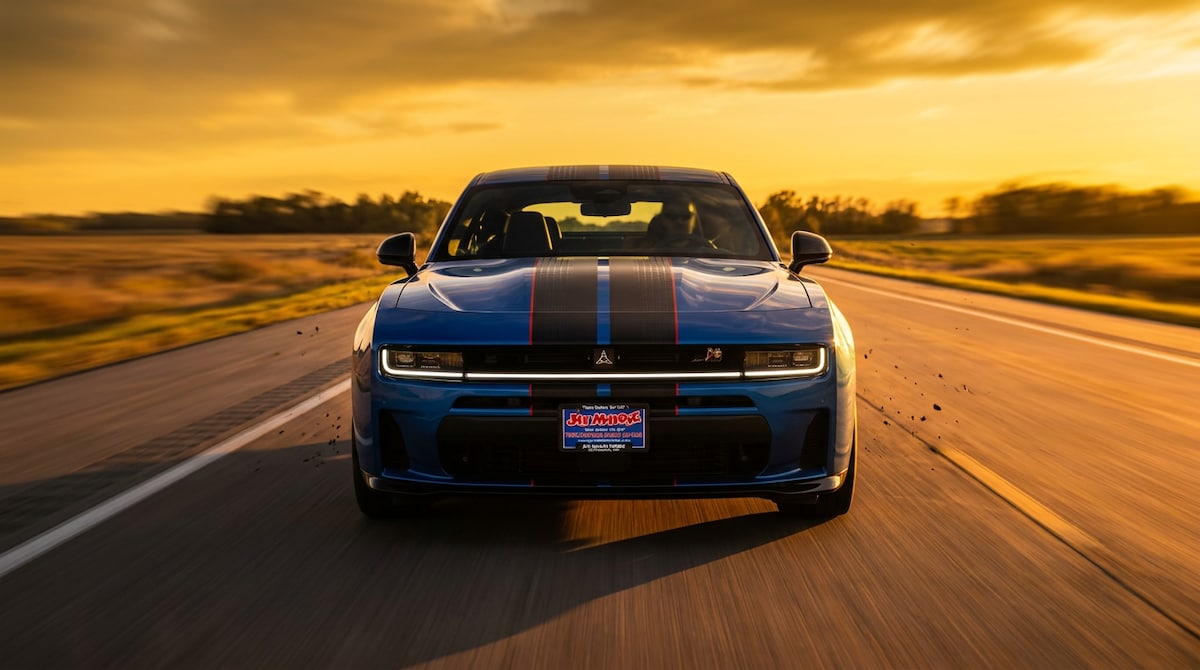
The 2026 Dodge Charger’s gas engine is the 3.0L Hurricane Twin-Turbo Inline-Six, badged as “SIXPACK” on the car. It replaces the 5.7L and 6.4L HEMI V8s that powered Chargers for almost two decades. It comes in two outputs: Standard Output (SO) at 420 horsepower in the R/T, and High Output (HO) at 550 horsepower in the Scat Pack. Both pair with an 8-speed automatic transmission, both deliver more horsepower than the V8s they replace, and both have generated more questions from our customers than any engine change in recent memory.
I’m Jordan Malone-Forst, Assistant General Manager at Jay Malone CDJR in Hutchinson. This is the deep-dive guide on the Hurricane SIXPACK — how it’s built, how it compares to the HEMI it replaces, what the SO and HO differences actually mean, why Dodge made the switch, and what the engine is genuinely like to drive in central Minnesota. If you’re cross-shopping the electric Daytona instead, see our gas vs electric comparison or our R/T vs Scat Pack guide. For the full lineup, see our 2026 Dodge Charger buyer’s guide.
What is the Hurricane SIXPACK engine?
The Hurricane SIXPACK is Stellantis’s 3.0-liter twin-turbocharged inline-six gasoline engine.
“Hurricane” is the family name (also used in Ram 1500, Wagoneer, and Grand Wagoneer applications). “SIXPACK” is the Charger-specific marketing badge — a callback to the original Dodge “Six Pack” setup from the 1970s, which used three two-barrel carburetors on a 440 V8. The modern SIXPACK has nothing to do with carburetors; the name is heritage marketing for a fully modern engine.
The basics:
- Displacement: 3.0 liters (2,993 cc)
- Cylinder layout: Inline-six, dual overhead cam, 24 valves
- Aspiration: Twin parallel turbochargers, water-cooled, with electronic wastegates
- Fuel system: Direct injection plus port injection (dual-injection)
- Transmission: 8-speed 880RE automatic only — no manual
- Drivetrain: Standard AWD with selectable RWD via front-axle disconnect
- Fuel requirement: 91-octane premium
The SIXPACK is built at Stellantis’s Saltillo Engine Plant in Mexico, the same facility that builds the Hurricane engines for Ram trucks. The block is cast iron with aluminum heads — a deliberate engineering choice that lets the engine handle high cylinder pressures from boost without the cost or weight concerns of an all-aluminum block.
Why did Dodge replace the HEMI V8?
Two reasons: regulations and performance.
On regulations, federal CAFE (Corporate Average Fuel Economy) standards have tightened steadily over the past 15 years, and the 5.7L and 6.4L HEMI V8s — for all their appeal — could no longer meet the targets without major compromise. The 5.7L HEMI R/T returned roughly 19 mpg combined; the 6.4L 392 V8 Scat Pack struggled to hit 17. Both ran on 91-octane premium. Pushing those engines further into the future would have required heavier hybridization, smaller displacement, or both — and Dodge chose a clean break instead.
On performance, the Hurricane is genuinely a better engine by the numbers. The Hurricane HO at 550 hp makes 65 more horsepower than the 6.4L 392 V8 it replaces, with about 11.8% more torque (531 lb-ft vs 475 lb-ft). The Hurricane SO at 420 hp makes 50 more horsepower than the 5.7L HEMI R/T, with 73 more lb-ft of torque (468 vs 395). Both Hurricane variants run quarter-mile times faster than the V8s they replace, and both deliver meaningfully better real-world fuel economy than the V8s they replace.
The honest trade-off is the sound. A V8 sounds like a V8, and an inline-six doesn’t. The Hurricane has a genuine, mechanical exhaust note — it’s not silent or anonymous — but it doesn’t deliver the loping cam-and-bypass rumble that made the HEMI iconic. For buyers who bought the previous Charger specifically for the V8 sound, that’s a real loss. For buyers who bought it for the speed, the Hurricane delivers more.
What’s the difference between the SO and HO Hurricane?
Same displacement, same block, same overall architecture — different internals and tune. What that means on the road:
| Spec |
Hurricane SO (R/T) |
Hurricane HO (Scat Pack) |
| Horsepower | 420 hp | 550 hp |
| Torque | 468 lb-ft | 531 lb-ft |
| 0-60 mph | 4.6 sec | 3.9 sec |
| Quarter mile | 12.9 sec | 12.2 sec |
| Top speed | 168 mph | 177 mph |
The HO is built to handle sustained high-output use without compromising reliability — it adds forged pistons, cross-bolted main caps, and dual oil pumps because the engine sees significantly higher loads. It runs about 30 psi of peak boost from twin 54mm Garrett GT2054 turbos, a lower 9.5:1 compression ratio, and a low-restriction intake and exhaust, and it requires 91-octane premium fuel. The SO is tuned for a balance of performance and efficiency. In normal driving both engines feel similar — smooth, immediate response, minimal turbo lag from the small twin turbos. The difference shows up when you demand acceleration: the SO pulls hard from low revs, while the HO keeps pulling through its 6,500-rpm redline.
How does the Hurricane compare to the HEMI V8 it replaces?
By the numbers, the Hurricane is a step forward in every quantifiable metric except sound. Direct comparisons:
| Spec |
5.7L HEMI R/T (old) |
Hurricane SO (new) |
| Displacement | 5.7 L V8 | 3.0 L I-6 twin-turbo |
| Horsepower | 370 hp | 420 hp (+50) |
| Torque | 395 lb-ft | 468 lb-ft (+73) |
| 0-60 mph | ~5.1 sec | 4.6 sec (-0.5) |
| Quarter mile | ~13.5 sec | 12.9 sec (-0.6) |
| Combined MPG | ~19 mpg | EPA estimates pending |
| Spec |
6.4L 392 V8 Scat Pack (old) |
Hurricane HO (new) |
| Displacement | 6.4 L V8 | 3.0 L I-6 twin-turbo |
| Horsepower | 485 hp | 550 hp (+65) |
| Torque | 475 lb-ft | 531 lb-ft (+56) |
| 0-60 mph | ~4.3 sec | 3.9 sec (-0.4) |
| Quarter mile | ~12.5 sec | 12.2 sec (-0.3) |
| Combined MPG | ~17 mpg | ~19 mpg (+2) |
Net of all that: the Hurricane SIXPACK is a meaningfully quicker engine in both R/T and Scat Pack forms than the V8s it replaces. The R/T gains a full half-second to 60 mph. The Scat Pack gains roughly four-tenths. And fuel economy improves on both versions. The trade-off is exhaust character, weight balance (the inline-six sits further back in the engine bay than the V8 did, giving slightly different handling), and a nostalgic feeling that doesn’t show up on a spec sheet.
How does the Hurricane SIXPACK work?
The Hurricane uses a few engineering choices that are worth understanding because they explain why it feels the way it does:
Twin parallel turbos. Two small turbochargers, one feeding cylinders 1-3 and the other feeding cylinders 4-6. Two small turbos spool faster than one large turbo, which means very little lag — throttle response feels nearly immediate.
Direct + port injection. Both fuel injection systems run simultaneously. Direct injection sprays fuel directly into the combustion chamber for precise control and cooling. Port injection sprays into the intake runner to keep the intake valves clean and reduce carbon buildup — a known long-term issue with pure direct-injection engines.
Electric water pumps and oil pumps. Reduces parasitic drag on the engine compared to belt-driven accessories. Also allows the cooling system to run when the engine is off (after a hard drive, for example).
Variable valve timing on both cams. The engine can adjust intake and exhaust valve timing independently to prioritize efficiency or power depending on driving demands.
Strong low-end torque. Most of the engine’s peak torque is available by about 2,500 rpm — letting it pull hard from just above idle, mimicking the low-end response of a large-displacement V8 without the V8’s fuel economy penalty.
What is the SIXPACK like to drive?
Three things stand out from behind the wheel:
Throttle response is instant. The small twin turbos build boost almost immediately. There’s essentially no lag — you press the pedal and the car goes. This is a meaningful improvement over single-turbo or larger-displacement turbo engines that have a noticeable delay between throttle input and acceleration.
The torque curve feels like a V8’s. Because most of the peak torque is available low in the rev range, the engine pulls hard from low rpm in any gear — you don’t need to wind it out to make speed. Stomp on the gas at 40 mph in 6th gear and the Hurricane responds. This is the engineering goal: deliver V8 driving character with an inline-six’s efficiency.
The 8-speed automatic is responsive. Paddle shifters give you full manual control. In Auto mode, the transmission predicts what you’ll want and pre-positions for the right gear — downshifts happen before you ask. In Sport or Track mode (Scat Pack), shifts are firm and immediate.
Cruising is quiet. The engine settles to about 1,600 rpm at 70 mph in 8th gear. Some intake whoosh under acceleration, some exhaust note under load, but at steady highway speed it fades into the background. This is different from the old HEMI, which always had a low rumble at idle and cruise.
What does the Hurricane SIXPACK sound like?
Honest answer: not like the HEMI V8, but not silent or anonymous either.
The Hurricane has a real mechanical exhaust note — an inline-six rasp that’s most prominent under hard acceleration and during downshifts. The HO Scat Pack’s low-restriction exhaust is louder and more aggressive than the SO R/T’s standard exhaust, but both are noticeably quieter at cruise than the V8s they replace.
For buyers who specifically loved the HEMI’s rumble — the cammy idle, the bass-heavy load notes — the SIXPACK won’t replace that experience. For buyers who care more about how quick the car is than how it sounds, the SIXPACK is genuinely better than the V8 it replaces.
Aftermarket exhaust options are already appearing from companies like Borla, MagnaFlow, and Direct Connection (Dodge’s in-house performance brand). Direct Connection sells a Cat-Back Exhaust Kit specifically for the SIXPACK that adds noticeable presence without affecting warranty. Worth considering if exhaust note matters and your stock system needs more.
How reliable is the Hurricane SIXPACK?
The Hurricane engine family is now in its third year of production across the Stellantis lineup — first introduced in 2023 Ram 1500, Wagoneer, and Grand Wagoneer. Field data so far has been encouraging:
- Cast iron block handles boost cleanly — no early failure patterns in the Ram applications
- Dual injection (direct + port) addresses the carbon buildup issue common to pure direct-injection engines
- Forged internals on the HO provide significant margin for sustained high-load use
- Warranty: Standard Stellantis 5-year / 60,000-mile powertrain warranty applies
No engine is bulletproof, and the Hurricane is too new for long-term high-mileage data (200,000+ miles). The HEMI V8 it replaces had legendary reliability records partly because it was such a simple, low-stressed design. The Hurricane is a more complex engine — twin turbos, electric pumps, dual injection — which means there are more components that can theoretically fail. Time will tell whether the engineering choices hold up over 15-year ownership timeframes the way the HEMI did.
Maintenance-wise, the SIXPACK follows the same intervals as the HEMI: oil changes every 7,500 miles using full-synthetic 0W-40, spark plugs at 60,000 miles, no required transmission service. The Hutchinson service team is fully trained on the Hurricane engine family and handles both SO and HO variants.
How does the SIXPACK perform in central Minnesota?
A few practical considerations for central Minnesota ownership:
Cold-start performance is excellent. The Hurricane uses electric heaters for the oil and coolant systems on the HO variant, plus a fast-warming combustion chamber design. Cold-weather starts feel close to instant even in deep-winter temperatures.
Fuel economy holds up in winter better than the V8 did. The smaller displacement and turbocharged design means the engine warms up faster and runs efficiently from a cold start — you don’t see the same winter mpg penalty as the HEMI.
Standard AWD is a real advantage on snow. Both SO and HO variants get the same AWD system with selectable RWD mode. For most central Minnesota commutes, leaving it in AWD year-round is the right answer.
Premium fuel is required. Both variants need 91-octane minimum. Make sure your regular fuel stop carries premium — in some rural Minnesota areas, premium availability is spotty.
Heated seats and steering wheel are standard on Scat Pack and Plus equipment groups. A nice quality-of-life feature for winter commuting.
Key Takeaways
- The Hurricane SIXPACK is Dodge’s 3.0L twin-turbo inline-six replacing the HEMI V8 lineup.
- Standard Output (SO) makes 420 hp / 468 lb-ft in the R/T; High Output (HO) makes 550 hp / 531 lb-ft in the Scat Pack.
- The HO uses forged pistons, cross-bolted main caps, twin oil pumps, a low-restriction intake/exhaust, and larger 54mm turbos.
- Hurricane SO makes 50 more hp than the 5.7L HEMI R/T and 73 more lb-ft of torque.
- Hurricane HO makes 65 more hp than the 6.4L 392 V8 with about 11.8% more torque (531 lb-ft vs 475 lb-ft).
- Both engines require 91-octane premium fuel and use the 8-speed 880RE automatic transmission.
- Most of the peak torque is available by about 2,500 rpm — V8-like low-end response with inline-six efficiency.
- Trade-off: the Hurricane doesn’t deliver the V8 exhaust note that made the HEMI iconic.
- Aftermarket exhaust options from Borla, MagnaFlow, and Direct Connection are available for more presence.
Frequently Asked Questions
What does SIXPACK stand for on the Charger?
SIXPACK is Dodge’s marketing badge for the 3.0L Hurricane Twin-Turbo Inline-Six engine. The name is a heritage callback to the original Dodge Six Pack engine from the 1970s, which used three two-barrel carburetors on a 440 V8. The modern SIXPACK has nothing to do with carburetors — the name is purely a heritage reference to the “six” in inline-six.
Why did Dodge get rid of the HEMI V8?
Federal fuel economy regulations and platform consolidation. The HEMI V8 couldn’t meet CAFE targets going forward, and the new STLA-Large platform was designed primarily around turbocharged and electrified powertrains rather than the big V8s. The Hurricane SIXPACK is also a quicker and more efficient engine than the V8s it replaces, so the move was both regulatory and performance-driven.
How much faster is the Hurricane than the HEMI?
The Hurricane SO R/T runs 0-60 in 4.6 seconds vs about 5.1 for the 5.7L HEMI R/T — a half-second improvement. The Hurricane HO Scat Pack runs 0-60 in 3.9 seconds vs about 4.3 for the 6.4L 392 V8 Scat Pack — roughly four-tenths quicker. Both Hurricane variants also run quarter-mile times faster than the V8s they replaced.
Does the Hurricane SIXPACK sound like a V8?
No. The inline-six layout produces a different exhaust note than a V8 — it’s a mechanical rasp under acceleration rather than the V8’s bass-heavy rumble. The Hurricane HO Scat Pack’s low-restriction exhaust is more aggressive than the SO R/T’s, but neither replaces the iconic HEMI sound. Aftermarket exhausts from Borla, MagnaFlow, and Direct Connection can add more presence.
Is the Hurricane SIXPACK reliable?
Field data from three years of Hurricane production in Ram 1500 and Wagoneer applications has been encouraging. The cast iron block handles boost cleanly, the dual-injection system addresses carbon buildup issues common to direct-injection engines, and the HO’s forged internals provide significant margin for high-output use. The engine is too new for long-term 200,000-mile data, but early indicators are positive. Standard Stellantis 5-year/60,000-mile powertrain warranty applies.
Does the Hurricane require premium fuel?
Yes — both SO and HO variants require 91-octane premium fuel at minimum. Using lower-octane fuel will reduce performance through the engine’s knock sensor adaptive tuning and may affect long-term reliability. Confirm your regular fuel source carries premium, especially in rural areas where availability can be inconsistent.
Can the Hurricane SIXPACK be tuned for more power?
Yes — aftermarket tuning is already emerging. Direct Connection (Dodge’s in-house performance brand) offers an authorized tune that adds approximately 60 hp to the HO variant. Third-party tuners like Hennessey have demonstrated 700+ hp builds on the HO platform with bolt-on modifications. Any aftermarket tune may affect warranty coverage — check with us at Jay Malone CDJR before modifying.
Will Dodge ever bring the V8 back to the Charger?
Stellantis hasn’t indicated any plans for a HEMI V8 return in the Charger. The STLA-Large platform isn’t configured for the HEMI V8 the way the previous Charger was, and the regulatory environment makes a return increasingly difficult. For 2026 and the foreseeable future, the Hurricane SIXPACK is the gas Charger engine.
The bottom line on the SIXPACK
The Hurricane SIXPACK is a genuinely impressive engine — quicker, more efficient, and arguably more sophisticated than the V8s it replaces. The honest trade-off is the exhaust note, and how much that matters is a personal call. Our customers tell us the old V8 sound is gone, but the speed gains are real — and after a few weeks of ownership, most stop missing the rumble.
Stop by Jay Malone CDJR and drive a SIXPACK Charger to judge for yourself. We’ll set up back-to-back drives with current inventory or factory-order your exact specs — and we never charge a locator fee to find or order the exact Charger you want.
About the Author
I’m Jordan Malone-Forst, Assistant General Manager at Jay Malone Motors in Hutchinson, MN. I’m proud to be part of the family business my dad Jay started in 2005 — and even prouder to serve the community I grew up in. If you have questions about any Chrysler, Dodge, Jeep, or Ram vehicle — or just want to talk through your options — reach out. I’d love to help.
Last reviewed July 2026 by Jordan Malone-Forst, Jay Malone CDJR.