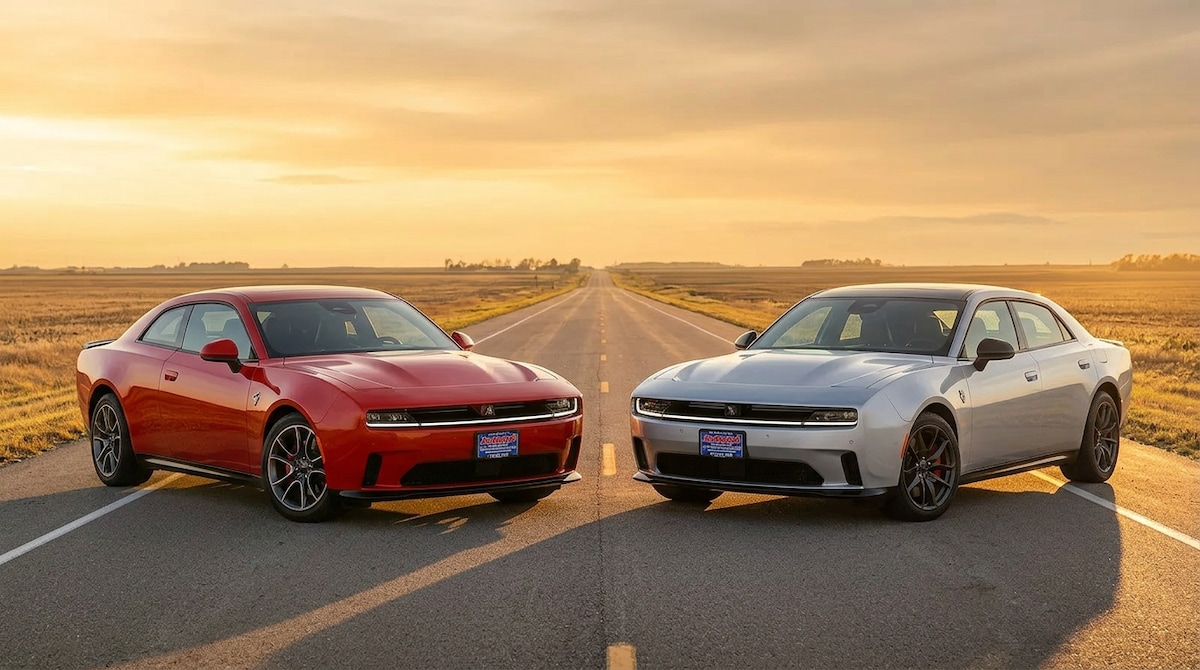
The 2026 Dodge Charger is one car with two completely different powertrains. The Charger SIXPACK is gas-powered, using the 3.0L Hurricane Twin-Turbo Inline-Six in either 420-horsepower (R/T) or 550-horsepower (Scat Pack) form. The Charger Daytona is fully electric — for 2026 it comes as the dual-motor AWD Daytona Scat Pack, making 630 horsepower (up to 670 with PowerShot) with an EPA-estimated 223 to 295 miles of range depending on tires and package. Same body, same widebody stance, same Dodge muscle DNA — very different driving experience and ownership math.
I’m Jordan Malone-Forst, Assistant General Manager at Jay Malone CDJR in Hutchinson. This guide is the honest, side-by-side breakdown of the 2026 Charger’s two powertrain paths — what each one does well, what the trade-offs are, and how to figure out which fits your life in central Minnesota. We don’t pressure customers toward one or the other, and we order both with no locator fee. For the full lineup, see our 2026 Dodge Charger buyer’s guide, our SIXPACK engine explainer, or our Daytona EV range & charging guide.
What’s the difference between the SIXPACK and Daytona?
The short version: SIXPACK is gas, Daytona is electric. Both wear the Charger nameplate, ride on the same STLA-Large platform with the same widebody stance, and come standard with all-wheel drive and a selectable rear-wheel-drive mode. The split happens in how they’re powered.
The SIXPACK name refers to the 3.0L Hurricane Twin-Turbo Inline-Six that replaces the HEMI V8. It comes in two outputs: a 420-horsepower Standard Output in the R/T and a 550-horsepower High Output in the Scat Pack, both paired with an 8-speed automatic. The Daytona is fully electric — for 2026, Dodge offers the electric Charger only as the dual-motor Daytona Scat Pack (the electric R/T was dropped for this model year), making 630 horsepower, or up to 670 with the PowerShot boost.
What do the SIXPACK and Daytona share?
Nearly everything except the powertrain.
Both Chargers share:
- The STLA-Large platform and widebody stance
- Standard all-wheel drive with a selectable rear-wheel-drive mode
- 2-door coupe and 4-door sedan body styles
- The 12.3-inch Uconnect 5 touchscreen and standard 20-inch wheels
- The same Dodge muscle-car design language, inside and out
Choose your powertrain, and the rest of the car comes along for the ride the same way.
What’s the case for the gas SIXPACK?
If you want a Charger that lives the traditional muscle car life — gas pump, exhaust note, no range planning — the SIXPACK is the answer.
Familiar ownership. Fill up at any station in a few minutes. No range planning, no charging setup, no software between you and your fuel. It works exactly like every Charger before it.
Lower entry cost. The gas SIXPACK is the more accessible way into a 2026 Charger — both the R/T and Scat Pack come in under the electric Daytona at the same body style. For current pricing on any configuration, reach out and we’ll get you exact numbers.
A real muscle-car sound. The Hurricane has a genuine mechanical exhaust note — not HEMI-loud, but immediate and unmistakably gas-powered. The Daytona’s Fratzonic exhaust is synthesized and divides opinion.
No cold-weather range penalty. A SIXPACK Charger returns the same fuel economy at 80 degrees or -20. An EV loses meaningful range in deep cold — a real consideration in a Minnesota winter.
What’s the case for the Daytona EV?
If you can charge at home and want the quickest, smoothest, most modern Charger, the Daytona Scat Pack makes a strong case.
It’s the quickest Charger you can buy. 630 horsepower (670 with PowerShot), 627 lb-ft of torque, and 0-60 in about 3.3 seconds — instant, from a standstill, every time, with no shifting. Dodge markets it as the world’s quickest and most powerful mass-produced electric muscle car.
Cheapest to fuel — if you charge at home. Charging overnight in your garage costs a fraction of gas per mile, and you start every morning full. That advantage shrinks if you rely on public DC fast charging.
Effortless daily driving. One-pedal driving, silent cruising, and instant response make it relaxed around town and genuinely fast when you want it. It carries a 100.5-kWh battery (93.9 kWh usable), charges at up to 11 kW on a home Level 2 connection, and peaks around 183 kW on a DC fast charger — roughly 5 to 80 percent in about 32.5 minutes on a 350-kW station.
The honest trade-offs: you need somewhere to charge, and Minnesota cold trims range in the winter months. For most drivers with home charging, day-to-day life is easier than gas; for those without it, the math gets harder.
How do the two lineups compare?
Here’s the 2026 Charger lineup by powertrain. Both gas trims and the Daytona Scat Pack come in 2-door and 4-door body styles.
| Model |
Powertrain |
Power |
| Charger R/T (SIXPACK) |
Gas 3.0L Hurricane SO |
420 hp |
| Charger Scat Pack (SIXPACK) |
Gas 3.0L Hurricane HO |
550 hp |
| Charger Daytona Scat Pack |
Electric dual-motor AWD |
630 hp (670 w/ PowerShot) |
Because pricing and incentives change — and EVs can carry their own separate incentives — we don’t publish figures here. Contact us and we’ll walk you through current pricing and any offers on either powertrain.
How does performance compare?
All three are genuinely fast. The electric Daytona Scat Pack is the quickest; the gas Scat Pack is close behind and sounds the part.
| Spec |
SIXPACK R/T |
SIXPACK Scat Pack |
Daytona Scat Pack |
| Horsepower |
420 hp |
550 hp |
630 hp (670 PowerShot) |
| Torque |
468 lb-ft |
531 lb-ft |
627 lb-ft |
| 0-60 mph |
4.6 sec |
3.9 sec |
3.3 sec |
| Quarter mile |
12.9 sec |
12.2 sec |
~11.6 sec |
| Drivetrain |
AWD (selectable RWD) |
AWD (selectable RWD) |
AWD (selectable RWD) |
| Fuel / range |
~20 mpg combined |
~19 mpg combined |
223–295 mi EPA |
What does cost of ownership look like?
The gas SIXPACK is simpler and cheaper to buy; the electric Daytona is typically cheaper to fuel and maintain if you can charge at home.
The SIXPACK uses premium fuel and needs standard maintenance (oil changes, etc.), but it’s the lower purchase price and there’s nothing new to learn. The Daytona has no oil changes and much lower “fuel” cost per mile when you charge at home overnight — but that advantage depends on having home charging, and it narrows if you lean on public DC fast charging. EVs may also qualify for separate incentives that can change the total picture.
Rather than publish estimates that vary by driver, rates, and incentives, we’ll run real numbers with you for your driving and your home setup. Contact our team and we’ll walk through it honestly.
Which 2026 Charger fits central Minnesota best?
It comes down to one question more than any other: can you charge at home?
- Choose the gas SIXPACK if: you can’t charge at home, you drive long rural distances, you want the muscle-car exhaust note, or you just want the simplest ownership with no range planning through a Minnesota winter.
- Choose the Daytona Scat Pack if: you can charge at home, most of your driving is regional, and you want the quickest, quietest, most modern Charger — and you’re comfortable planning around reduced range on the coldest days.
For a lot of Hutchinson and McLeod County drivers with a garage and a mostly-local routine, the Daytona is genuinely easy to live with. For those in the country or without home charging, the SIXPACK is the safer, simpler pick.
How do I choose between the SIXPACK and Daytona?
Four honest questions to ask yourself:
Can you charge at home? If yes, the Daytona is on the table. If no, the SIXPACK is almost certainly the better fit.
How far do you drive, and where? Mostly local and regional favors the EV; long rural hauls with sparse charging favor gas.
How much does the sound matter? If a real gas exhaust note is part of the muscle-car experience for you, the SIXPACK delivers it; the Daytona’s synthesized exhaust doesn’t.
Do you want the quickest, most modern version? The electric Daytona Scat Pack is quicker than either gas trim and effortlessly smooth day to day.
My honest read: if you have home charging and drive mostly regionally, test-drive the Daytona — a lot of people are surprised how much they like it. If you don’t, or you want the classic gas muscle-car experience, the SIXPACK won’t disappoint. Come drive both at Jay Malone CDJR and the right answer usually becomes clear fast.
Key Takeaways
- The 2026 Charger comes gas (SIXPACK) or electric (Daytona), on the same body and platform.
- SIXPACK: 420 hp R/T or 550 hp Scat Pack, 3.0L Hurricane twin-turbo I-6, 8-speed automatic.
- Daytona: for 2026 it’s the dual-motor Scat Pack only — 630 hp (670 with PowerShot), 627 lb-ft, 0-60 in about 3.3 sec, 223–295 mi EPA range. (The electric R/T was dropped for this model year.)
- Both come standard with AWD and a selectable RWD mode, in 2-door and 4-door.
- The biggest deciding factor is home charging: with it, the Daytona is easy to live with; without it, the SIXPACK is the simpler pick — especially through a Minnesota winter.
Frequently Asked Questions
Is the 2026 Charger gas or electric?
Both. The Charger SIXPACK is gas (3.0L Hurricane twin-turbo I-6, 420 hp R/T or 550 hp Scat Pack), and the Charger Daytona is fully electric. For 2026 the electric Daytona is offered as the dual-motor Scat Pack, making 630 hp (up to 670 with PowerShot).
Which 2026 Charger is quickest?
The electric Daytona Scat Pack — 0-60 in about 3.3 seconds, quicker than the gas Scat Pack (3.9) or R/T (4.6). Dodge markets it as the world’s quickest and most powerful mass-produced electric muscle car.
How much more powerful is the Hurricane Scat Pack than the old HEMI?
The SIXPACK R/T (420 hp) makes 50 more horsepower and 73 more lb-ft than the 5.7L HEMI R/T it replaces — about 18.5% more torque. The SIXPACK Scat Pack (550 hp / 531 lb-ft) makes 65 more horsepower than the 6.4L 392 V8, with about 11.8% more torque (531 vs 475 lb-ft).
How far can the electric Daytona go on a charge?
The 2026 Daytona Scat Pack is EPA-estimated between about 223 miles (with the Track Package’s performance tires) and 295 miles (in its most efficient configuration). Expect reduced range in deep-winter cold, as with any EV.
Do I need home charging to own the Daytona?
Not strictly, but it’s what makes ownership easy and cheap. Charging overnight at home means you start full every day at a fraction of gas cost per mile. Without home charging you’d rely on public DC fast charging, which is slower and more expensive — in that case the gas SIXPACK usually makes more sense.
Which is better for Minnesota winters?
Both come with standard AWD, so both handle snow well. The difference is range: the gas SIXPACK returns the same economy in any temperature, while the electric Daytona loses some range in deep cold. If you can charge at home and plan around it, the Daytona is still very livable; if not, the SIXPACK is the simpler winter pick.
How much does each one cost?
The gas SIXPACK is the more accessible way into a 2026 Charger, and EVs can carry separate incentives that affect the total. Because pricing and incentives change, we don’t publish figures here — contact our team and we’ll give you exact, current numbers on either powertrain.
About the Author
I’m Jordan Malone-Forst, Assistant General Manager at Jay Malone Motors in Hutchinson, MN. I’m proud to be part of the family business my dad Jay started in 2005 — and even prouder to serve the community I grew up in. If you have questions about any Chrysler, Dodge, Jeep, or Ram vehicle — or just want to talk through your options — reach out. I’d love to help.
Last reviewed July 2026 by Jordan Malone-Forst, Jay Malone CDJR.