💵
Value My Car → We Buy Cars — Even If You Don’t Buy From Us.
Get a real offer on your vehicle in minutes. No obligation, no pressure.





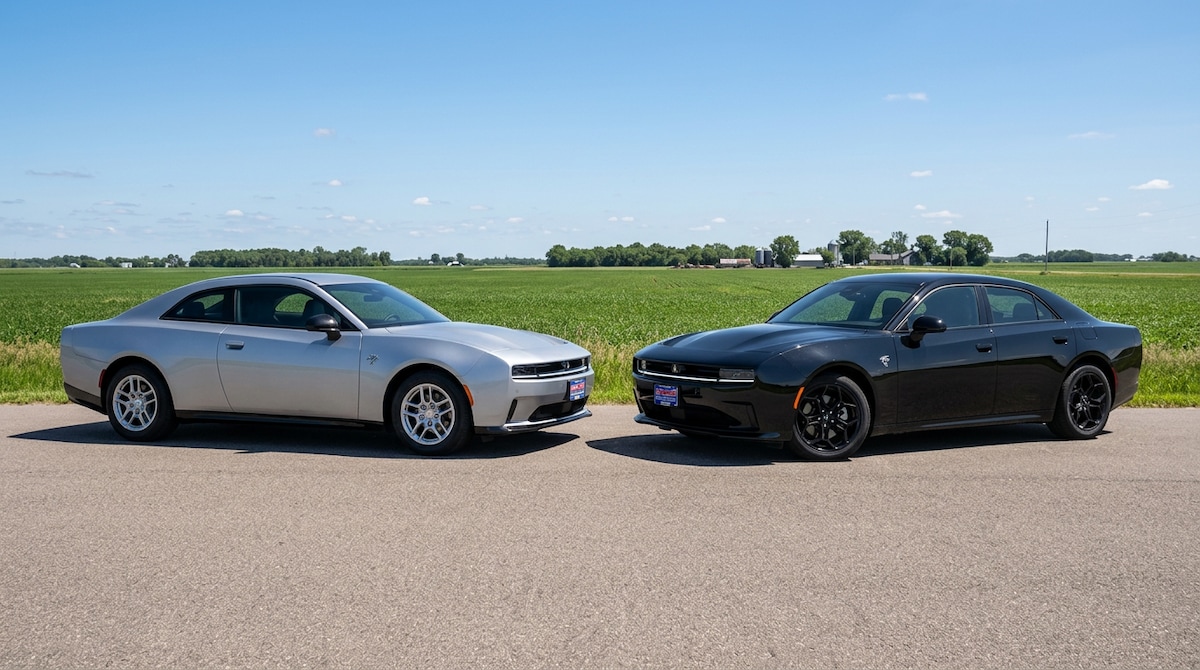
For the first time, the 2026 Dodge Charger is available as both a 2-door coupe and a 4-door sedan in the same model year. Same widebody chassis. Same powertrains (gas SIXPACK or Daytona EV). Same standard AWD with selectable RWD mode. The 2-door has the more aggressive presence; the 4-door adds easier rear-seat access through standard rear doors. And the SIXPACK 4-door is genuinely the world’s only four-door muscle car in 2026 production.
I’m Jordan Malone-Forst, Assistant General Manager at Jay Malone CDJR in Hutchinson. This guide walks through every meaningful difference between the 2-door and 4-door 2026 Charger — what they share, what they don’t, what each one’s actually like to live with day-to-day, and how to choose the right body style for your life. For the full lineup including gas vs electric and trim-level decisions, see our 2026 Dodge Charger buyer’s guide, our gas vs electric comparison, or our R/T vs Scat Pack breakdown.
In this guide:
It comes down to how often you actually carry rear-seat passengers and how much you value visual aggression versus everyday practicality.
Buy the 2-door coupe if: you want the most aggressive, traditional muscle car look, you rarely carry rear-seat passengers, and you don’t mind tilting the seat forward to reach the back.
Buy the 4-door sedan if: you regularly carry passengers, you want easier access to the rear seat through standard rear doors, and you don’t mind a modest price premium at the same trim level.
There’s no wrong answer. Both body styles share the widebody chassis, the 121-inch wheelbase, all powertrain options, all standard AWD/RWD capability, and all interior tech. The 4-door isn’t a soft compromise — it’s genuinely the same muscle car with a different door count.
Nearly everything. The 2026 Charger was designed from the start as a single platform that supports both body styles — not a sedan with two doors removed, or a coupe that was stretched.
Both share:
They’re essentially identical. Because the 2-door and 4-door share the same platform, wheelbase, floor, and roofline, they measure the same length and nearly the same height.
| Dimension | 2-Door Coupe | 4-Door Sedan |
|---|---|---|
| Wheelbase | 121 in | 121 in |
| Length | 206.6 in | 206.6 in |
| Width | ~80 in | ~80 in |
| Height | 58.9 in | 59.0 in |
| Curb weight (SIXPACK R/T) | ~4,800 lb | ~4,900 lb |
| Cargo space (rear hatch) | ~22.7 cu ft | ~22.7 cu ft |
| Cargo with seats folded | ~37.4 cu ft | ~37.4 cu ft |
| Front-door length | Long (single door) | Standard |
| Rear access | Tilt-forward seat | Rear door |
The 2-door and 4-door are the same length (206.6 in) and nearly identical in height (58.9 vs 59.0 in) — dimensionally they’re the same car. Dodge built both on a shared floor and roof, so the only real differences are door count and the resulting cabin access.
Both body styles use the same “hidden hatchback” design and carry the same cargo — about 22.7 cubic feet behind the rear seats and 37.4 cubic feet with the seats folded.
2-door coupe: ~22.7 cubic feet behind the rear seats with the hatch raised, expanding to ~37.4 cubic feet with the rear seats folded.
4-door sedan: ~22.7 cubic feet behind the rear seats, expanding to ~37.4 cubic feet with the rear seats folded.
Because the two body styles share the same floor and roofline, cargo capacity is effectively identical — the real day-to-day difference is rear-seat access, not cargo room.
The hidden hatchback design is genuinely useful. From outside, both Chargers look like traditional sedans — the cargo opening doesn’t telegraph “hatchback.” But when you raise the hatch, you have the full rear opening for loading large items. For a muscle car, this is a meaningful practicality upgrade over a traditional trunk.
Whether you regularly haul large items (Costco runs, hunting gear, snowboards, kids’ sports equipment) or mostly carry a couple of bags and the occasional grocery run, both body styles give you the same ~22.7 cu ft to work with.
This is the single biggest practical difference between the body styles. Both Chargers seat five adults and share the same wheelbase, so rear legroom is similar — about 37.2 inches in both. But getting into and out of the rear seat is dramatically different.
2-door coupe rear access: The front seat tilts forward and slides forward via a single lever. Rear-seat passengers climb in around the front seatback. The opening is decent for adults but awkward for car seats, especially booster seats. Wearing a winter coat or carrying a bag adds friction. For occasional rear-seat use, it works fine. For daily use with passengers, it gets old fast.
4-door sedan rear access: Standard rear doors. Open the door, get in, close the door. Same as any sedan. For families with kids, regular passenger duty, or just preferring the option to use the rear seat without ceremony, this is the obvious advantage.
A practical note for parents: child seats and booster seats are functionally easier to install and use in the 4-door. The 2-door coupe requires reaching across the front seat each time, which is workable but inconvenient.
Yes — the 4-door carries a modest premium over the equivalent 2-door at the same trim level.
For buyers who actually use the rear seat, the step up to the 4-door is genuinely good value for the added everyday usability. Because pricing and incentives change regularly, we don’t publish figures here — reach out and we’ll give you exact, current numbers on any configuration you’re considering.
Most trims are available in both 2-door and 4-door form, with a few exceptions.
| Trim | 2-Door Available | 4-Door Available |
|---|---|---|
| SIXPACK R/T | Yes | Yes |
| SIXPACK Scat Pack | Yes | Yes |
| Daytona R/T BEV | No (4-door only) | Yes (factory order) |
| Daytona Scat Pack BEV | Yes | Yes |
For 2026, the 2-door coupe arrived at dealers first in the model year rollout, with 4-door sedan availability phasing in through the year. As of mid-2026, both body styles are in production. The Daytona R/T BEV is the one exception — it’s a 4-door, factory-order-only configuration through Dodge’s EE Traders channel.
In 2026, virtually every other production muscle car is a 2-door coupe. The Charger 4-door stands alone.
The Mustang is a 2-door coupe (and convertible) with no 4-door variant. The Chevrolet Camaro was discontinued after the 2024 model year and was 2-door only. The Toyota Supra is 2-door only. European performance sedans (BMW M, Mercedes-AMG, Audi RS) exist, but those are luxury sport sedans rather than traditional American muscle.
The previous-generation Charger was a 4-door sedan — the only such option in the muscle car category, and always 4-door. The new lineup is the first time you can choose 2-door or 4-door within the same model year, preserving the segment niche the brand has occupied for two decades while finally offering the traditional 2-door muscle car shape.
For buyers who genuinely need rear-door access and want real performance, the 4-door Charger is a category of one. There’s nothing else on the market that combines 550–670 horsepower, traditional muscle car styling, and four-door practicality.
Five honest questions to ask yourself:
Do you regularly carry rear-seat passengers? If yes (kids, adult passengers, friends), the 4-door is the obvious choice. If no, the 2-door works fine.
Do you transport kids in car seats? The 4-door makes installing and using car seats dramatically easier.
How important is the most aggressive look? The 2-door coupe has the most traditional muscle car presence. The 4-door is still aggressive but feels slightly more practical.
How important is easy rear-seat and cargo access? Both body styles carry the same ~22.7 cu ft, but the 4-door’s rear doors make loading the back seat far easier day to day.
Does a modest price premium change your decision? If the extra cost matters, the coupe is the value pick; if not, the 4-door is the practical upgrade.
My honest read: for most central Minnesota buyers, the 4-door makes more sense. The visual aggression of the 2-door is real, but the practical benefits of the 4-door — rear-door access, easier kid and passenger duty — add up. The 2-door makes sense for buyers who specifically value the iconic coupe look and rarely carry passengers. Come drive both at Jay Malone CDJR and the right answer usually becomes obvious within five minutes.
Key Takeaways
Both. The 2026 Charger is offered as a 2-door coupe and a 4-door sedan across both gas SIXPACK and Daytona BEV powertrain families. You choose at order time. The 4-door carries a modest premium over the equivalent 2-door.
The 4-door carries a modest premium over the equivalent 2-door at the same trim level. Because pricing and incentives change, we don’t publish figures here — contact our team and we’ll give you exact, current numbers on any configuration.
Nearly. The 4-door weighs approximately 100 pounds more than the 2-door — a small enough difference that 0-60 times are within a tenth of a second of each other. All powertrains, transmissions, and drivetrains are identical between body styles.
Yes — the 2-door has the same LATCH anchors as the 4-door. But installing and accessing car seats is more convenient in the 4-door because of its standard rear doors. In the 2-door, you reach around the tilted front seat each time, which is workable but inconvenient for daily use.
Cargo is the same in both. Each body style offers approximately 22.7 cubic feet behind the rear seats, expanding to about 37.4 cubic feet with the rear seats folded. Both use the “hidden hatchback” design, and because they share the same floor and roofline, cargo capacity is effectively identical.
Competing muscle cars — the Mustang and the discontinued Camaro — are 2-door only. The previous Charger sedan was the only 4-door muscle car for two decades, and Dodge has continued that tradition while adding the 2-door variant for 2026. European performance sedans (BMW M, Mercedes-AMG) exist but are categorized as luxury sport sedans rather than traditional American muscle.
Mostly. SIXPACK R/T, SIXPACK Scat Pack, and Daytona Scat Pack BEV are all available in both body styles. The Daytona R/T BEV is 4-door only as a factory-order configuration through Dodge’s EE Traders channel.
Too early to know for sure since both are first-year-on-sale for 2026. Historically, lower-production coupe variants of muscle cars have held value slightly better than sedan variants when both existed. But the 4-door Charger’s unique market position (only 4-door muscle car) may support stronger resale than typical sedan depreciation patterns. We’ll have meaningful data after 3-4 years.
About the Author
I’m Jordan Malone-Forst, Assistant General Manager at Jay Malone Motors in Hutchinson, MN. I’m proud to be part of the family business my dad Jay started in 2005 — and even prouder to serve the community I grew up in. If you have questions about any Chrysler, Dodge, Jeep, or Ram vehicle — or just want to talk through your options — reach out. I’d love to help.
Last reviewed July 2026 by Jordan Malone-Forst, Jay Malone CDJR.