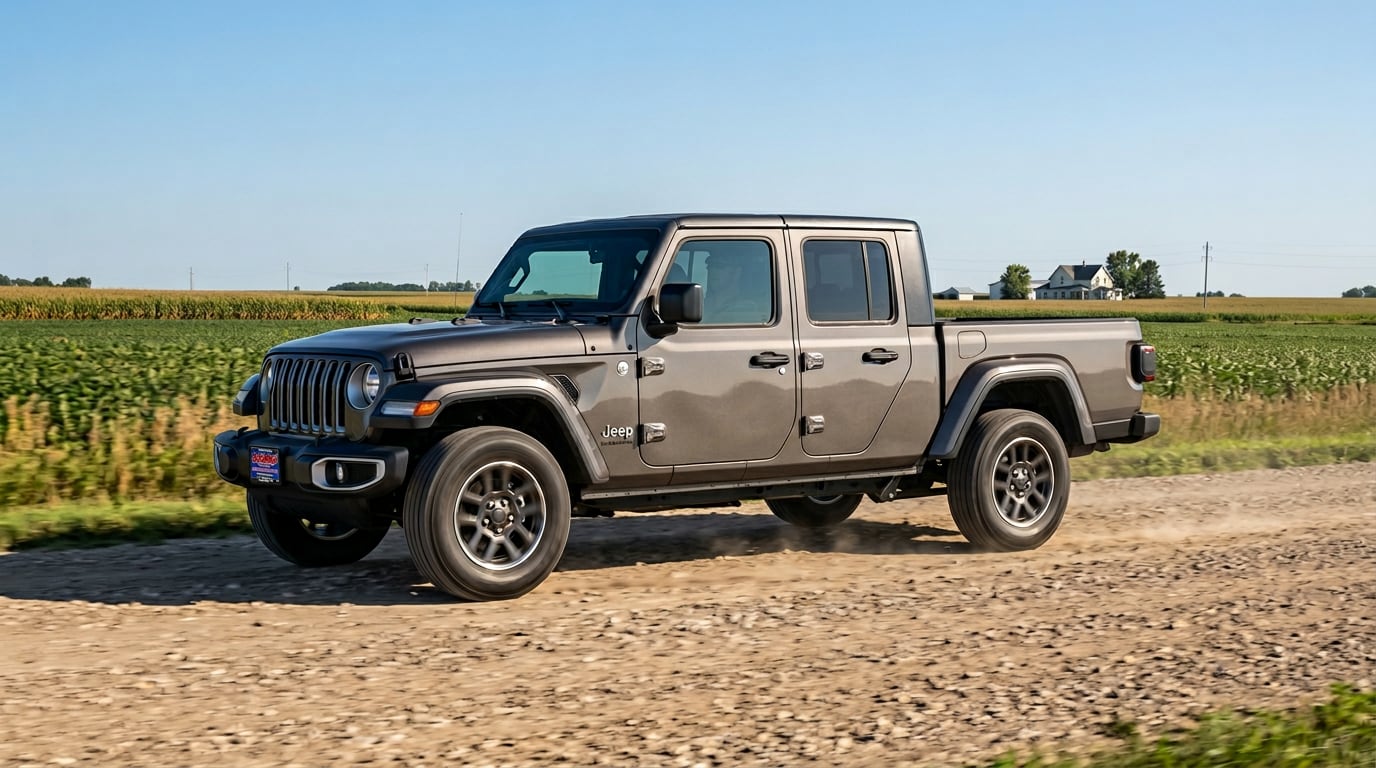
The 2026 Jeep® Wrangler and Gladiator are first cousins. They share a platform, the same removable doors, the same fold-down windshield, the same legendary off-road DNA. But they aren’t the same vehicle — and the choice between them is a real one. The Wrangler is shorter, lighter, less expensive to start, and offers powertrain options the Gladiator doesn’t (including the 2.0L Hurricane turbo, the 4xe plug-in hybrid, and the 6.4L V8 in the Moab 392). The Gladiator gives up those engine choices in exchange for a real five-foot bed, full pickup framing, and meaningful additional towing and payload.
I’m Jordan Malone-Forst, Assistant General Manager at Jay Malone CDJR in Hutchinson. This guide walks through every meaningful difference between the 2026 Wrangler and 2026 Gladiator — size, engine options, towing, off-road, value, and which one actually fits central Minnesota use cases. For more depth on either vehicle, see our 2026 Gladiator buyer’s guide or our 2026 Wrangler buyer’s guide.
Quick Answer
The 2026 Jeep Wrangler and Gladiator share a platform but differ in three core ways: bed, towing, and engine choice. The Gladiator adds a 5-foot steel bed, tows up to 7,700 lbs, and carries up to 1,720 lbs of payload. The Wrangler 4-door tows up to 3,500 lbs (or up to 5,000 lbs on the 4-door Rubicon properly equipped) and offers engine options the Gladiator doesn’t — the 2.0L Hurricane Turbo, the 4xe plug-in hybrid, and the 6.4L V8 in the Moab 392. The Gladiator is V6 automatic only; the Wrangler still offers a 6-speed manual with the V6. Buy a Gladiator if you need to tow, haul, or use a bed. Buy a Wrangler if you don’t.
What do the Wrangler and Gladiator have in common?
The Wrangler and Gladiator share more than they don’t. Both ride on a body-on-frame platform with solid axles front and rear. Both have removable doors, removable tops, a fold-down windshield, and the same family of soft-top, three-piece hard top, and Sunrider for Hardtop options. Both come standard 4x4 with Command-Trac, available with Rock-Trac on Rubicon variants. Both wear the seven-slot grille, the same headlight design, and the same Trail Rated® capability standards.
Inside, the dashboard, switchgear, infotainment, and most of the interior is shared between the two. The 12.3-inch Uconnect 5 touchscreen is standard on both. The same Convenience Group, Safety Group, and Technology Group bundles are available on both. If you sat in a Wrangler Sahara and a Gladiator Sahara back to back, you’d find them nearly identical from the dashboard forward.
From the firewall back, that’s where the differences start.
How big is the Gladiator vs the Wrangler?
The Gladiator is meaningfully bigger than the Wrangler. It rides on a longer wheelbase to accommodate the bed, which makes it more stable on highway but harder to maneuver in tight spots. The Wrangler 4-Door (the only Wrangler that’s a fair size comparison) is dramatically shorter:
| Dimension |
Wrangler 4-Door |
Gladiator |
| Wheelbase |
118.4 in |
137.3 in |
| Overall length |
188.4 in |
218.0 in |
| Width |
73.8 in |
73.8 in |
| Height |
73.6 in |
75.0 in |
| Curb weight (typical) |
~4,300 lb |
~5,000 lb |
| Bed |
None (cargo area) |
5-foot steel bed |
The Gladiator is essentially two and a half feet longer than a Wrangler 4-Door, with a wheelbase nearly 19 inches longer. That difference matters in two ways: parking and trail driving. The Gladiator needs more space to park anywhere, and on tight technical trails, the longer wheelbase reduces approach and departure clearance and makes turning radius a real consideration. On highway, the longer wheelbase actually helps — the Gladiator is more stable and rides better at speed than a Wrangler.
What engines are available on the Wrangler vs Gladiator?
This is where the trucks diverge most. The Wrangler offers four powertrains for 2026 — the V6, the 2.0L turbo, the V8 (in the Moab 392), and the plug-in hybrid 4xe. The Gladiator is V6 only.
| Engine |
Wrangler |
Gladiator |
| 3.6L Pentastar V6 (285 hp) |
Standard / available |
Standard on every trim |
| 2.0L Hurricane Turbo I-4 (270 hp) |
Available on most trims |
Not available |
| 6.4L V8 HEMI (470 hp) |
Available (Moab 392 only) |
Not available |
| 4xe Plug-In Hybrid (375 hp combined) |
Available |
Not available |
| Manual transmission |
Available with V6 (Sport, Rubicon) |
Not available |
If you want a V8 Jeep, you have to buy a Wrangler — that’s the only place the 6.4L HEMI lives in the lineup, and only in the Moab 392. If you want a manual transmission, same answer — Gladiator is automatic only. If you want a plug-in hybrid Jeep, only the Wrangler 4xe and the Grand Cherokee 4xe offer that powertrain. The Gladiator’s single 3.6L V6 with the 8-speed automatic is a proven, reliable, capable powertrain — but it’s the only powertrain on offer. For a deeper dive on Wrangler engine choices specifically, see our 2026 Jeep Wrangler engine guide.
How does towing compare between Wrangler and Gladiator?
The Gladiator wins on towing — but the gap is smaller than most buyers expect, especially if you’re comparing a Wrangler Rubicon 4-Door to a Gladiator. Here’s the breakdown:
| Configuration |
Max Tow Rating |
Max Payload |
| Wrangler 2-Door (any trim) |
2,000 lbs |
~1,000 lbs |
| Wrangler 4-Door (non-Rubicon) |
3,500 lbs |
~1,000 lbs |
| Wrangler 4-Door Rubicon (auto, 4.10 axle) |
5,000 lbs |
~1,100 lbs |
| Gladiator (properly equipped) |
7,700 lbs |
1,720 lbs |
A few important specifics to know: the 5,000-lb Wrangler rating is available only on the 4-Door Rubicon with the 8-speed automatic, the 4.10 axle ratio, LT285/70R17C off-road tires, and the heavy-duty full-float rear axle. If those boxes aren’t all checked, you’re looking at the 3,500-lb 4-Door rating or the 2,000-lb 2-Door rating. The Gladiator’s 7,700-lb maximum requires the Max Tow Package, which adds the 4.10 axle ratio, heavy-duty engine cooling, and a higher-output alternator. Properly equipped, both vehicles can tow within those limits with confidence.
What that translates to in real use:
- Wrangler 4-Door (non-Rubicon) can pull: small utility trailers, jet skis, small open trailers, lightweight pop-up campers, single-place ATV trailers, smaller bass boats
- Wrangler 4-Door Rubicon (properly equipped) can also pull: mid-size bass boats up to about 4,500 lbs loaded, smaller pontoon boats, two-place snowmobile trailers, smaller livestock trailers, R-Pod and teardrop campers
- Gladiator can pull, but Wrangler typically cannot: ski boats over 5,000 lbs, full multi-place snowmobile trailers loaded, full UTV trailers with cargo, mid-size travel trailers, mid-size enclosed cargo trailers, larger livestock trailers
Same story on payload. The Wrangler’s available payload tops out around 1,000–1,100 lb depending on trim. The Gladiator’s available payload reaches 1,720 lb — class-leading among gas mid-size trucks. If you regularly haul heavy gear, multiple passengers plus a trailer, or anything that uses up payload quickly, the Gladiator is the right tool.
Which Jeep is more capable off-road?
Honest answer: the Wrangler is more capable on tight, technical, slow-speed terrain. The Gladiator is more capable on terrain where the bed and towing matter (overlanding, hunting trips, work-truck applications). The reasons:
- Wheelbase: The Wrangler’s shorter 118-inch wheelbase gives it better breakover angle and tighter turning radius. On a switchback trail or between trees, the Wrangler clears terrain a Gladiator gets caught up on.
- Approach/departure: Both Rubicons have similar angles, but the Gladiator’s longer body means a slightly steeper approach is required to avoid scraping.
- Weight: The Gladiator weighs roughly 700 lb more than a comparable Wrangler. That extra mass takes more shock travel to absorb on rough terrain and more grip to keep moving on slick climbs.
- Lockers and gearing: Identical between Wrangler Rubicon and Gladiator Rubicon — same 4:1 Rock-Trac, same lockers, same disconnecting front sway bar.
- Carrying capacity: The Gladiator carries gear, fuel, water, and recovery equipment that a Wrangler can’t carry without a roof rack and a trailer. For overlanding, that’s a real advantage.
For Wrangler-specific off-road systems and how Trail Rated capability works, see our 2026 Jeep Wrangler off-road capability guide.
Is the Wrangler or Gladiator a better value?
The Wrangler is less expensive to start at every comparable trim level — you’re not paying for the bed, the longer wheelbase, the larger axles, or the higher tow and payload ratings. Whether that’s the better value depends entirely on whether you’ll use those things.
| Trim Level |
Wrangler 4-Door |
Gladiator |
| Sport / Sport S |
Available |
Available |
| Willys |
Available (M210/M220 axles, rear e-locker) |
Available (Willys nameplate) |
| Sahara |
Available (Selec-Trac full-time 4WD) |
Not available |
| Rubicon |
Available (Rock-Trac 4:1, F+R e-lockers) |
Available (Rock-Trac 4:1, F+R e-lockers) |
| Mojave (desert spec) |
Not available |
Available (Fox shocks, high-speed off-road) |
| V8 / Moab 392 |
Available (only Jeep with the 6.4L V8) |
Not available |
Ask about current MSRP at our Hutchinson dealership — pricing changes regularly with incentives, packages, and inventory. The Gladiator costs more for the same trim level because you’re buying truck framing, the bed, longer wheelbase, larger axles, and higher tow/payload capacity. If you don’t need those things, you’re paying for capability you won’t use. If you do need them, the Gladiator is the right tool. For Wrangler trim-by-trim breakdowns, see our 2026 Jeep Wrangler trim levels guide.
How does daily driving compare?
Both are honest off-road vehicles, which means both have firmer rides than a Toyota Highlander or a Ford Edge. But between the two, the Gladiator rides better on highway. The longer wheelbase smooths out road imperfections and the additional mass damps high-frequency bumps that the Wrangler transmits more directly. The Gladiator is also more stable in crosswinds — the Wrangler 4-Door can feel noticeably nervous in a strong gusting wind.
In town, that flips. The Wrangler is dramatically easier to park, easier to maneuver in parking lots, easier to fit in a one-car garage. A Gladiator is a full-size truck for parking purposes — you’ll need to think about driveway length, garage depth, and whether you can fit it through a drive-through. If you live in a city or a tight-driveway suburban setup, that matters.
Fuel economy is comparable for similar configurations — both deliver around 17–22 mpg combined depending on engine, drivetrain, and trim. Neither is a fuel economy champ.
Real central Minnesota use cases — which one fits which life?
Strip away the marketing and look at what people in central Minnesota actually do. Here’s how each vehicle fits real use cases we see at the Jay Malone CDJR lot in Hutchinson:
Buy a Wrangler if:
- You want a fun second vehicle for summer top-off driving and winter snow capability
- You don’t need to tow more than a small or mid-size trailer (and on a Rubicon properly equipped, up to about 5,000 lbs is achievable)
- You park in a tight garage, drive in town a lot, or value a tighter turning radius
- You want the V8 (Moab 392) or the plug-in hybrid (4xe) — only available on Wrangler
- You want a manual transmission — Gladiator is automatic only
- You go off-road on technical, tight trails (hunting cabin trails, wooded terrain, switchbacks)
Buy a Gladiator if:
- You need to tow regularly above the Wrangler’s ceiling — ski boats, full snowmobile trailers, UTV trailers, mid-size campers
- You haul gear — hunting, ice fishing, ATV trips, work tools, lumber, mulch
- You need a real bed for messy or tall cargo a Wrangler’s cargo area can’t handle
- You overland or take long trips — the bed carries fuel cans, recovery gear, coolers
- You drive on highway a lot — the longer wheelbase rides better at speed
- You want a Jeep that’s also a working pickup truck — one vehicle does both jobs
How do I choose between the Wrangler and Gladiator?
“Honest test: would you genuinely use a five-foot bed at least once a month? If yes, the Gladiator is the right call — the cargo flexibility makes everyday Jeep ownership dramatically more practical. If no, the Wrangler is the better value because you’re not paying for towing and bed capacity you won’t use, and you get the Wrangler’s tighter dimensions and more powertrain choices.”
— Jordan Malone-Forst, Assistant General Manager
A few honest patterns we see at our Hutchinson dealership:
- Customers who already own a truck for work and want a fun open-air weekend Jeep almost always pick a Wrangler
- Customers who’ve been driving a Tacoma or a Ranger and want a Jeep alternative almost always pick a Gladiator
- Customers who tow boats or sleds above 5,000 lbs regularly almost always pick a Gladiator
- Customers who want a V8 Jeep are buying a Moab 392 Wrangler — that engine isn’t available in Gladiator
- Customers who want a plug-in hybrid Jeep are buying the Wrangler 4xe or the Grand Cherokee 4xe — the Gladiator doesn’t offer a 4xe variant
- Customers who do serious technical wheeling lean Wrangler for the shorter wheelbase
- Customers who overland or take long off-road trips lean Gladiator for the cargo capacity
Best advice: come drive both. Jay Malone CDJR keeps both Wranglers and Gladiators in stock, and we can usually arrange back-to-back test drives in 30 minutes. The size difference becomes obvious immediately. The towing/bed value becomes obvious when you see them parked next to each other. Pick the one that fits your life, not the one that sounds cooler on paper.
Key Takeaways
- The Wrangler and Gladiator share a platform, dashboard, infotainment, off-road DNA, and the open-air features that define the Jeep brand
- The Gladiator is 30 inches longer than a Wrangler 4-Door, with a 19-inch longer wheelbase and a 5-foot steel bed
- Wrangler offers the V6, 2.0L Hurricane turbo, 6.4L V8 (Moab 392), and 4xe plug-in hybrid; Gladiator is V6 only
- Wrangler still offers a 6-speed manual; Gladiator is automatic only
- Wrangler 4-Door tows up to 3,500 lbs; Wrangler 4-Door Rubicon up to 5,000 lbs properly equipped; Gladiator up to 7,700 lbs
- Gladiator’s available 4x4 payload reaches 1,720 lb — class-leading; Wrangler tops out around 1,100 lb
- Wrangler is more capable on tight technical trails; Gladiator is more capable on overlanding and trips with heavy gear
- For most central Minnesota buyers, the question is simple: do you need a bed? If yes, Gladiator. If no, Wrangler is the better value
Frequently Asked Questions
Is the Gladiator just a Wrangler with a bed?
Roughly, yes — but with significant differences. The Gladiator is built on a stretched Wrangler platform with a longer wheelbase, a fully-framed pickup bed (not a unitized cargo area), and stronger front and rear axles. The dashboard and front of the cabin are nearly identical to a Wrangler 4-Door, but everything from the B-pillar back is unique to the Gladiator.
How much can a 2026 Jeep Wrangler actually tow?
The 2026 Wrangler 2-Door tows up to 2,000 lbs. The 2026 Wrangler 4-Door (non-Rubicon) tows up to 3,500 lbs. The 2026 Wrangler 4-Door Rubicon, properly equipped with the 8-speed automatic, 4.10 axle ratio, LT285/70R17C off-road tires, and the heavy-duty full-float rear axle, tows up to 5,000 lbs. That 5,000 lb rating is genuinely useful for mid-size bass boats, two-place snowmobile trailers, R-Pod and teardrop campers, and smaller livestock trailers. For higher tow needs above 5,000 lbs, the Gladiator (up to 7,700 lbs) is the right choice.
Can a Wrangler tow a small camper?
Up to 3,500 lbs on a 4-Door non-Rubicon, or up to 5,000 lbs on a 4-Door Rubicon properly equipped. That range covers most pop-up campers, teardrop trailers, R-Pods, and smaller travel trailers. If your camper’s loaded weight exceeds 5,000 lbs — and many mid-size travel trailers do once you add water, batteries, gear, and tongue-mounted accessories — you need a Gladiator or larger truck. The Gladiator’s 7,700-lb max tow rating handles most mini campers and mid-size travel trailers comfortably.
Which Jeep is better for snow?
Both are excellent in snow. Both come standard 4x4. Both can be optioned with off-road tires that handle deep snow well. The Wrangler has a slight edge on trail snow because of its shorter wheelbase. The Gladiator has a slight edge for highway winter driving because of better stability at speed. For most Minnesota winter use cases, you can’t go wrong either way — pick based on the rest of your needs.
Can I get a manual transmission Gladiator?
No. The 2026 Gladiator is offered only with the 8-speed automatic. If a manual is a hard requirement, you need a Wrangler — the 6-speed manual is available with the V6 on the Sport and Rubicon trims.
Does the Gladiator come in a V8 like the Wrangler Moab 392?
No. The 6.4L HEMI V8 is exclusive to the Wrangler in the Jeep lineup, and only in the Moab 392 (which replaces the previous Rubicon 392 nameplate for 2026). Jeep has not announced a Gladiator 392, and given the V8’s production constraints in the Wrangler, it’s unlikely to come to Gladiator. Every 2026 Gladiator uses the 3.6L Pentastar V6.
Are Wrangler and Gladiator tops interchangeable?
No. Although the front Freedom Panels are similar in concept, the rear top sections are different sizes between Wrangler and Gladiator because the rear cabins are different. A Wrangler hard top will not fit a Gladiator and vice versa. The doors and the front Freedom Panels (the small panels above the front seats) are largely interchangeable. For Wrangler-specific top options, see our 2026 Jeep Wrangler top options guide.
Does Jay Malone CDJR carry both Wranglers and Gladiators?
Yes — both are core Jeep models for our Hutchinson dealership and we keep both in stock most of the time. We can usually arrange back-to-back test drives so you can feel the size and ride differences in person. Reach out and we’ll set it up.
There’s no wrong answer between the 2026 Wrangler and Gladiator — just different tools for different lives. The Wrangler is the right Jeep for someone who wants the open-air experience without a bed, with more powertrain choices, and at a lower starting point. The Gladiator is the right Jeep for someone who needs to tow above 5,000 lbs, haul gear, or carry serious cargo and wants a real pickup that’s also a real Jeep. Stop in at Jay Malone CDJR in Hutchinson and we’ll set up a side-by-side test drive. Once you feel the difference, the choice usually makes itself.
— Jordan Malone-Forst, Jay Malone Motors
About the Author
I’m Jordan Malone-Forst, Assistant General Manager at Jay Malone Motors in Hutchinson, MN. I’m proud to be part of the family business my dad Jay started in 2005 — and even prouder to serve the community I grew up in. When I’m not at the dealership, you’ll find me involved with the Hutchinson Ambassadors and Chamber of Commerce. If you’re trying to decide between a Wrangler and a Gladiator, reach out — I’d love to help you figure it out.