



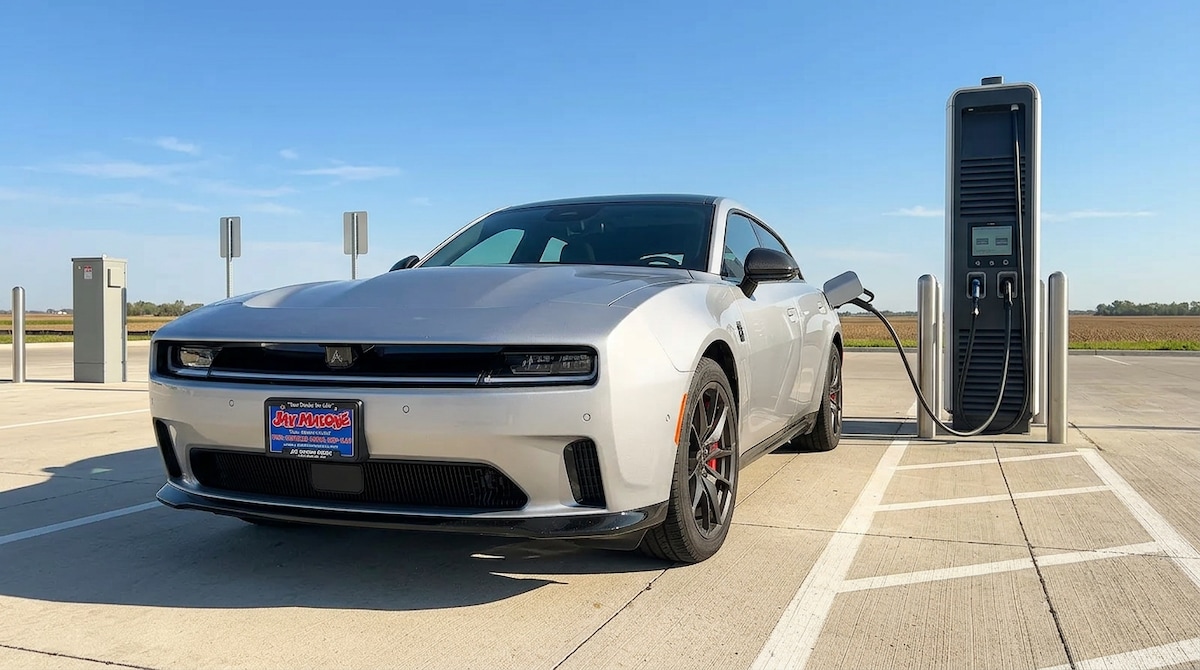
The 2026 Dodge Charger Daytona is the first fully electric muscle car Dodge has ever sold — and for central Minnesota buyers, the questions about range and charging are real. For 2026 the electric Daytona comes as the dual-motor AWD Scat Pack, making 630 horsepower (up to 670 with PowerShot) with an EPA-estimated range from about 223 miles (with the Track Package’s performance tires) up to roughly 295 miles in its most efficient configuration. The 100.5-kWh battery (93.9 kWh usable) supports DC fast-charging up to 183 kW and Level 2 home charging up to 11 kW. At about 3.3 seconds 0-60, the Daytona Scat Pack is Dodge’s quickest muscle car and the quickest, most powerful mass-produced electric muscle car on the market.
I’m Jordan Malone-Forst, Assistant General Manager at Jay Malone CDJR in Hutchinson. This is the honest breakdown of what Daytona ownership actually looks like in central Minnesota — real-world range, cold-weather impact, home and public charging, and whether the Daytona makes sense for your driving. If you’re cross-shopping the gas SIXPACK, see our gas vs electric comparison, or the 2026 Charger buyer’s guide for the full lineup.
What is the 2026 Charger Daytona’s EPA range?
The 2026 Daytona Scat Pack is EPA-estimated between about 223 and 295 miles, depending on tires and package.
| Configuration | Power | EPA range (est.) |
|---|---|---|
| Daytona Scat Pack (standard tires) | 630 hp (670 PowerShot) | up to ~295 mi |
| Daytona Scat Pack w/ Track Package | 630 hp (670 PowerShot) | ~223 mi |
For 2026, Dodge offers the electric Daytona only as the Scat Pack (the electric R/T was dropped for this model year). The Track Package’s wider, stickier performance tires trade some range for grip — the standard setup is the one to pick if maximum range matters to you.
What’s in the Daytona’s battery and drivetrain?
A 100.5-kWh battery (93.9 kWh usable) on a 400-volt architecture, driving a dual-motor all-wheel-drive system.
The Daytona Scat Pack makes 630 horsepower (670 with the PowerShot push-to-pass boost) and 627 lb-ft of torque, with standard all-wheel drive and a selectable rear-wheel-drive mode. It charges at up to 11 kW on a Level 2 home connection and peaks around 183 kW on a DC fast charger — roughly 5 to 80 percent in about 32.5 minutes on a 350-kW station. The battery carries Dodge’s standard 8-year / 100,000-mile EV battery warranty.
How much range does the Daytona lose in a Minnesota winter?
Expect meaningful winter range loss, like any EV — plan for it rather than be surprised by it.
EVs lose range in the cold because the battery works harder and cabin heat draws power. As a general rule of thumb (not a Dodge-published figure), plan for roughly 15–30% less range in deep-winter temperatures, with the biggest hit on the coldest days and on short trips where the car never fully warms up. Two things soften it: preconditioning the cabin and battery while still plugged in, and the standard heat pump, which heats more efficiently than resistive heating. For most central Minnesota drivers with home charging and a mostly-local routine, winter range is a planning consideration, not a dealbreaker.
What does home charging require?
A 240-volt Level 2 setup in your garage is what makes Daytona ownership easy — you plug in overnight and start every day full.
The Daytona accepts up to 11 kW on Level 2, which is enough to refill a mostly-depleted battery overnight. You’ll want either a dedicated 240V outlet or a hardwired Level 2 wall unit, installed by a licensed electrician — the cost depends entirely on your home’s electrical panel and how far the run is from it to the garage. A standard 120V household outlet works in a pinch but only adds a few miles per hour, so it’s really just a backup. If you’re not sure what your home needs, we’re happy to talk it through and point you toward a local electrician for a quote.
Where can I publicly fast-charge around central Minnesota?
Public DC fast charging is available along the main corridors, and it’s expanding — use a charging app to find live stations near you.
For day-to-day driving around Hutchinson and McLeod County, most owners charge at home and rarely need public charging. For longer trips, DC fast chargers are concentrated along the interstate corridors (I-94, I-35) and around the Twin Cities metro, with more being added regularly. Apps like PlugShare, A Better Route Planner, and the Dodge/Uconnect trip planner will show you live, up-to-date station locations and availability along your route — that’s more reliable than any static list, since the network changes fast. On a 350-kW station the Daytona can go from about 5 to 80 percent in roughly half an hour.
Can I take a Daytona on long trips?
Yes — regional trips from Hutchinson are easy, and longer hauls just need one planned fast-charge stop.
| Trip from Hutchinson | Distance | Stops needed |
|---|---|---|
| Round-trip to Twin Cities (MSP) | ~110 mi | None (single charge) |
| Round-trip to Willmar | ~80 mi | None (single charge) |
| Round-trip to Duluth | ~340 mi | One stop, ~30–40 min |
| Round-trip to Fargo | ~390 mi | One stop, ~30–40 min |
| One-way to Chicago | ~410 mi | One stop, ~30–40 min |
Distances and stops are estimates and will vary with speed, weather, and how full you start. In deep winter, plan for the reduced range above.
What does Daytona ownership cost to run?
If you charge at home, the Daytona is cheaper to fuel and maintain than a comparable gas Charger — the exact numbers depend on your electricity rate and driving.
Charging overnight at home typically costs a fraction of gas per mile, and an EV has no oil changes and fewer wear items than a gas engine. That said, the savings depend on your home electricity rate and whether you can charge at home versus relying on public fast charging. EVs may also qualify for separate incentives that shift the total picture. Rather than publish estimates that vary by household, we’ll run real numbers with you for your rate and your driving — reach out and we’ll walk through it honestly.
What does the Daytona feel like to drive?
Instant, silent, and genuinely fast — with a synthesized Fratzonic exhaust you can turn up or down.
Electric torque arrives the instant you touch the pedal, so the Daytona feels immediate in a way no gas car quite matches — 0-60 in about 3.3 seconds, with no shifting and no lag. Around town it’s relaxed and quiet, with one-pedal driving; when you want it, it’s ferociously quick. The Fratzonic Chambered Exhaust pipes in a synthesized muscle-car sound that you can dial up for drama or turn down for a silent cruise. It’s a different experience from the gas SIXPACK — some drivers love it, some miss a real exhaust note. The only way to know which camp you’re in is to drive it.
Is the Daytona right for you?
The Daytona is a great fit if you can charge at home and drive mostly regionally — and a harder sell if you can’t.
- The Daytona makes sense if: you have (or can install) home charging, most of your driving is around central Minnesota and the metro, and you want the quickest, quietest, most modern Charger.
- Look at the gas SIXPACK instead if: you can’t charge at home, you regularly drive long rural distances with sparse charging, or you want the classic gas exhaust note and zero range planning through winter.
My honest take: for a lot of Hutchinson and McLeod County drivers with a garage and a mostly-local routine, the Daytona is easier to live with than people expect — and it’s ferociously fast. If home charging isn’t in the cards, the gas SIXPACK is the smarter buy. Come drive the Daytona at Jay Malone CDJR and see which way you lean.
Key Takeaways
- For 2026 the electric Charger Daytona is the dual-motor AWD Scat Pack: 630 hp (670 with PowerShot), 627 lb-ft, 0-60 in about 3.3 seconds.
- EPA range runs from about 223 miles (Track Package tires) up to ~295 miles (most efficient configuration).
- 100.5-kWh battery (93.9 usable), 400V; up to 11 kW Level 2 home charging and up to 183 kW DC fast charging (~5–80% in about 32.5 minutes).
- Plan for roughly 15–30% less range in deep-winter cold; preconditioning and the standard heat pump help.
- Home charging is what makes ownership easy — with it, the Daytona is very livable in central Minnesota; without it, the gas SIXPACK is the simpler pick.
- Battery warranty: 8 years / 100,000 miles.
Frequently Asked Questions
How far can the 2026 Charger Daytona go on a charge?
The 2026 Daytona Scat Pack is EPA-estimated between about 223 miles (with the Track Package’s performance tires) and roughly 295 miles (in its most efficient configuration). Expect reduced range in deep-winter cold.
How much range does the Daytona lose in winter?
As a general EV rule of thumb, plan for roughly 15–30% less range in deep-winter temperatures, with the biggest hit on the coldest days and shortest trips. Preconditioning while plugged in and the standard heat pump both help reduce the loss.
What does it take to install Level 2 home charging?
You’ll want a 240-volt circuit in the garage — either a dedicated outlet or a hardwired Level 2 wall unit, installed by a licensed electrician. The cost depends entirely on your home’s electrical panel and the distance to the garage, so it’s best to get an electrician’s quote. We’re happy to talk through what your setup needs.
How long does it take to fast-charge the Daytona?
On a 350-kW DC fast charger the Daytona peaks around 183 kW and goes from about 5 to 80 percent in roughly 32.5 minutes. At home on Level 2 (up to 11 kW), a mostly-depleted battery refills overnight.
Can the Daytona use Tesla Superchargers?
The Daytona uses a CCS charge port, and much of the Tesla Supercharger network has opened to non-Tesla EVs using an adapter. Availability and adapter compatibility are evolving, so check the current setup for your car — we can point you to what applies at the time you buy.
How long will the Daytona battery last?
The battery is covered by Dodge’s standard 8-year / 100,000-mile EV battery warranty. Modern EV batteries are engineered to outlast that, with gradual capacity fade rather than sudden failure.
Does the Daytona qualify for federal EV tax credits?
EV tax-credit rules change and depend on the vehicle, how it’s acquired, and your situation. Rather than quote a figure that may be out of date, check the current federal guidance or ask us — we’ll point you to the latest and to any applicable incentives.
Can I turn off the artificial exhaust sound?
Yes. The Fratzonic Chambered Exhaust is adjustable — you can turn the synthesized sound up for a muscle-car feel or down for a silent, quiet cruise.
About the Author
I’m Jordan Malone-Forst, Assistant General Manager at Jay Malone Motors in Hutchinson, MN. I’m proud to be part of the family business my dad Jay started in 2005 — and even prouder to serve the community I grew up in. If you have questions about any Chrysler, Dodge, Jeep, or Ram vehicle — or just want to talk through your options — reach out. I’d love to help.
Last reviewed July 2026 by Jordan Malone-Forst, Jay Malone CDJR.
Categories:
New Inventory