💵
Value My Car → We Buy Cars — Even If You Don’t Buy From Us.
Get a real offer on your vehicle in minutes. No obligation, no pressure.




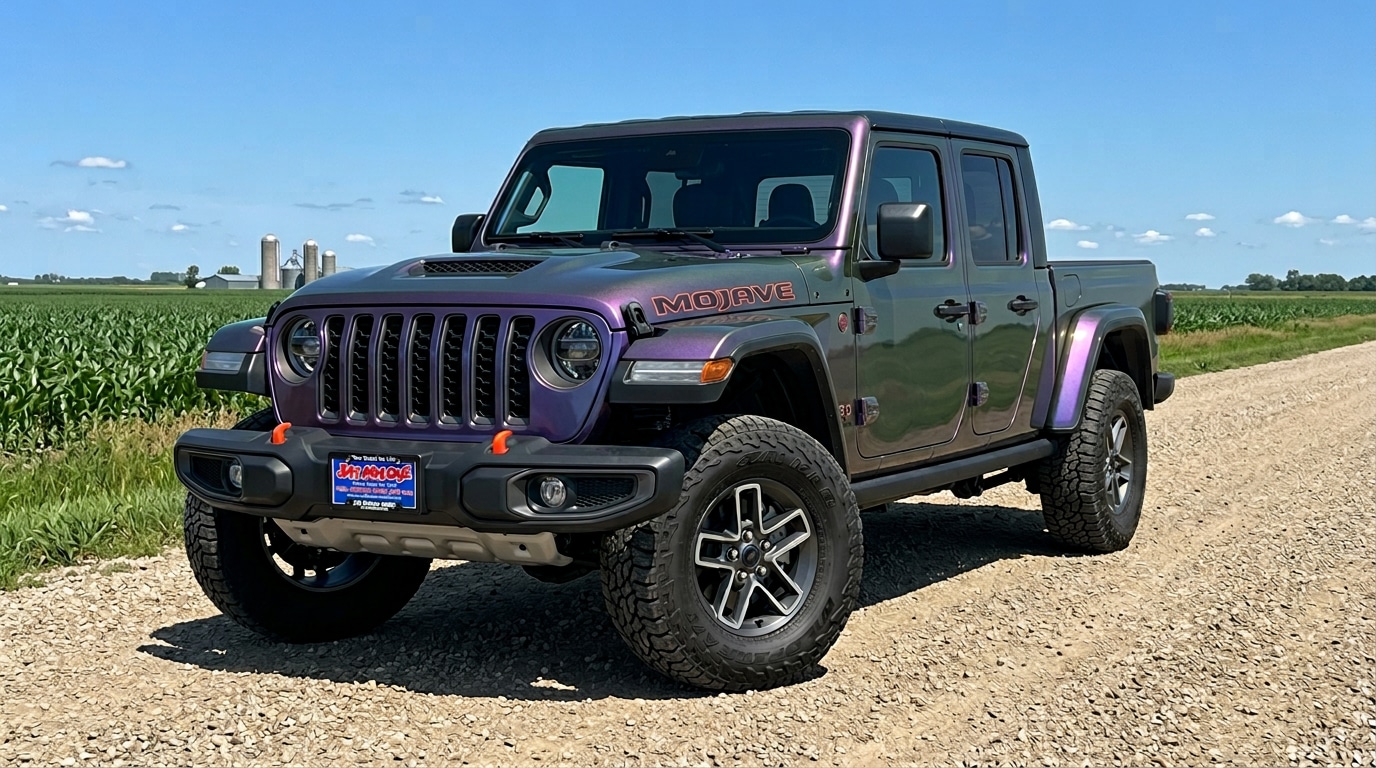
The 2026 Jeep® Gladiator Rubicon and Mojave wear the same Trail Rated® badge, share the same V6 engine, and look like cousins on the lot. But they’re built for completely opposite kinds of off-road work. The Rubicon is a slow-speed rock crawler with a 4:1 transfer case, lockers front and rear, and a disconnecting front sway bar. The Mojave is a high-speed desert runner with Fox internal by-pass shocks, hydraulic jounce bumpers, a reinforced frame, and a single rear locker. Same family, different missions.
I’m Jordan Malone-Forst, Assistant General Manager at Jay Malone CDJR in Hutchinson. This guide walks through every meaningful difference between the 2026 Gladiator Rubicon and Mojave — the hardware, the price, the use case, and which one actually fits central Minnesota terrain. For the full lineup context, see our 2026 Gladiator buyer’s guide.
Jump to a section
The short version: the Rubicon is built to crawl, the Mojave is built to fly. The Rubicon’s hardware is tuned for low-speed technical terrain — rocks, ledges, deep mud, articulation over uneven ground. Everything about it favors slow, deliberate movement with maximum traction and wheel travel. The Mojave’s hardware is tuned for high-speed off-road — whoops, washboard, fast desert runs, sudden compressions. It’s built to absorb impacts at speed, not to articulate over a boulder.
Both are real Trail Rated® trucks. Both share the 3.6L Pentastar V6 (285 hp / 260 lb-ft) and the 8-speed automatic. Both have the same five-foot bed, the same removable doors, the same 12.3-inch Uconnect 5 standard. Where they diverge is the suspension, the lockers, the transfer case, and the body armor. Those differences add up to two trucks that feel completely different on the trail.
Here’s the side-by-side breakdown of every meaningful off-road specification, pulled directly from the 2026 Gladiator order guide:
| Feature | Rubicon | Mojave |
|---|---|---|
| Transfer case | Rock-Trac, 4:1 low range | Command-Trac, 2.72:1 low range |
| Front locker | Electronic locking front axle | No front locker |
| Rear locker | Electronic locking rear axle | Electronic locking rear axle |
| Front sway bar | Electronic disconnecting | Standard front stabilizer bar |
| Front shocks | Red Tenneco | Fox Performance internal by-pass |
| Rear shocks | Red Tenneco | Fox Performance internal by-pass |
| Jounce bumpers | Standard | Fox hydraulic jounce bumpers |
| Suspension tune | Performance suspension | Performance suspension (desert-tuned) |
| Front axle | Dana M210 wide | Dana M210 wide |
| Rear axle | Dana M220 wide | Dana M220 wide |
| Axle ratio | 4.10 | 4.10 |
| Standard tires | LT285/70R17C all-terrain | LT285/70R17C all-terrain |
| Front bumper | Mold-in color (steel optional) | Mold-in color (steel optional) |
| Trail Rated badge | Red/grey | Orange Desert Rated |
| Off-Road Plus mode | Standard | Standard |
Three differences matter most: the transfer case, the lockers, and the shocks. The 4:1 vs 2.72:1 low range is huge for slow-speed crawling. The front locker and disconnecting sway bar give the Rubicon articulation and traction the Mojave can’t match. And the Fox shocks give the Mojave high-speed compression control the Rubicon can’t touch.
The suspension is the headline difference. The Rubicon runs red Tenneco shocks at all four corners — good shocks, but tuned for slow-speed articulation and ride compliance, not for absorbing big hits at speed. The disconnecting front sway bar lets the front axle articulate dramatically when you’re crawling over uneven terrain — one wheel can be three feet higher than the other and the truck just walks through it.
The Mojave runs Fox Performance internal by-pass shocks front and rear. These are the same family of shocks you’d find on prerunners and trophy trucks — they have multiple zones inside the shock body that change damping based on shock position, so light-duty trail driving feels compliant but big high-speed hits get firm damping that prevents bottoming out. On top of that, the Mojave adds Fox hydraulic jounce bumpers — basically a secondary shock that engages only when the suspension is fully compressed, soaking up the kind of impacts that would otherwise damage the frame.
Translation: the Rubicon will out-articulate the Mojave at slow speeds. The Mojave will absorb high-speed hits the Rubicon can’t. On the highway, both feel similar — firm but not punishing. On washboard gravel, the Mojave is dramatically smoother. On rocks, the Rubicon does work the Mojave can’t do.
The Rubicon has the most capable factory drivetrain in the segment. Rock-Trac with a 4:1 low range means at low speeds in 4-low, the engine can crank through obstacles where other 4x4s would stall — you can idle up a steep rocky pitch instead of needing throttle. Both axles can be locked electronically, which means even if three wheels are off the ground, the fourth is still trying to push the truck forward. And the disconnecting front sway bar — not available on any Mojave — is what lets the front axle articulate enough to keep tires on the ground in extreme terrain.
The Mojave uses a Command-Trac transfer case with a 2.72:1 low range. That’s plenty for high-speed off-road, but it’s a different tool. The Mojave has only a rear locker — no front locker — and a fixed front sway bar for high-speed stability. If you’re imagining an obstacle where you need maximum articulation and traction, that’s a Rubicon job. If you’re imagining a fast washboard road where you need stability through corners, that’s a Mojave job. Both have Off-Road Plus mode for terrain-specific calibration.
Both come standard with LT285/70R17C all-terrain tires — that’s a 33-inch tire with a load-rated C carcass. The Rubicon ships on 17x7.5 mach/painted black wheels with black pockets. The Mojave ships on 17x7.5 mach/painted dark gray wheels. Both can be optioned with LT285/70R17C BSW mud-terrain tires for an extra $495 MSRP if you want more aggressive tread for mud and snow.
Same tire size on both means the ground clearance and approach/departure angles are nearly identical. The functional difference comes down to suspension travel and how the trucks deliver power, not how high they sit off the ground.
Both Rubicon and Mojave come with a Class IV receiver hitch standard, the trailer-tow wiring harness, heavy-duty engine cooling, and the Trailer Hitch Zoom backup camera feature. Both have the same 4.10 axle ratio. Tow ratings on a properly equipped Gladiator reach up to 7,700 lb, but Rubicon and Mojave aren’t the trucks Jeep tunes for the absolute maximum tow rating — that’s the Sport S with the Max Tow Package. Rubicon and Mojave are tuned for capability and ride, not for max tow.
Always check the door-jamb sticker on your specific truck for the actual rated capacity, especially if you’re towing close to the limit. Adding a winch, steel bumpers, or other accessories will reduce payload, and the Mojave X (with the Steel Bumper Group standard) and Rubicon X (with the Warn winch standard) both add weight that comes off your usable payload number.
The 2026 Rubicon and Mojave start within $700 of each other. Then each platform has higher trims that add appearance, comfort, and tech content:
| Trim | Mission | MSRP |
|---|---|---|
| Gladiator Rubicon | Rock crawler base | $52,520 |
| Gladiator Mojave | Desert runner base | $53,215 |
| Rubicon Shadow Ops | Rubicon hardware + appearance/tech | $57,515 |
| Rubicon X | Fully-loaded crawler with winch standard | $60,515 |
| Mojave X | Fully-loaded desert truck with steel bumpers | $61,210 |
All prices add the $1,995 destination charge. The base Rubicon at $52,520 is the lowest price of admission for the rock-crawling hardware. The base Mojave at $53,215 is the lowest price for the desert hardware. From there, the X variants add safety, technology, and convenience content but don’t change the underlying off-road equipment.
For most central Minnesota Gladiator buyers, the Rubicon is the right call. Here’s the honest reasoning:
The Mojave isn’t the wrong answer though. If you spend most of your time on rough secondary roads — long stretches of washboard gravel on McLeod, Meeker, or Renville county roads — the Mojave will give you a noticeably smoother ride at speed than the Rubicon. The same is true if you take regular trips out west to ride trails in the Badlands or the Black Hills. The Mojave is a niche tool here, but for the right buyer it’s the better tool.
Three honest questions to ask yourself:
Best advice: come drive both. Jay Malone CDJR keeps Rubicons on the lot most of the time, and we can usually arrange a Mojave for a test drive within a few days if we don’t have one in stock. Driving them back to back makes the choice obvious.
Key Takeaways
On pavement, no — they have the same engine and transmission. Off-road, yes — the Mojave can sustain higher speeds on rough terrain because the Fox internal by-pass shocks absorb impacts the Rubicon’s shocks would transmit straight into the chassis. On a fast washboard road, the Mojave is dramatically more comfortable at speed.
The Mojave can handle moderate technical terrain — it has a rear locker, the same wide axles as the Rubicon, and 33-inch all-terrains. But it doesn’t have the 4:1 Rock-Trac low range, the front locker, or the disconnecting sway bar that make the Rubicon legendary on rocks. For serious technical crawling, the Rubicon is the right tool.
Both are good in snow. They run the same 33-inch all-terrain tires, the same 4WD systems with low range, and similar ground clearance. The Rubicon’s front locker is more useful in deep snow where you need traction at all four corners. The Mojave’s Fox shocks don’t add much value in snow specifically. For most central Minnesota winter use cases, both work; the Rubicon has a slight edge.
Aftermarket, yes — Fox sells direct-fit shocks for the Gladiator that bolt to a Rubicon, and aftermarket front locker conversions exist. But you can’t buy them factory, and adding a front locker after the fact is expensive enough that it usually makes more sense to buy the right platform up front. Aftermarket Fox shocks on a Rubicon are common and reasonably priced; aftermarket lockers on a Mojave are rare.
Not standard. The Mojave X comes standard with the Steel Bumper Group (steel front and rear bumpers, rock protection sill rails) but doesn’t include a winch. The Rubicon X comes standard with a Warn electric front winch as part of the Steel Bumper Group. On the base Rubicon, you can add the Capability Package, which bundles the steel bumper plus the Warn winch. On the base Mojave, the winch is a Mopar add-on.
Yes — both wear the Trail Rated® badge, but the Mojave wears the only orange Desert Rated® version of that badge in the Jeep lineup. Trail Rated certification means a vehicle has passed Jeep’s benchmarks in five categories: traction, ground clearance, articulation, maneuverability, and water fording. The Mojave passes the same benchmarks as the Rubicon despite its different hardware tuning.
Yes — we factory-order from Toledo without charging a locator fee. Mojaves are rarer in central Minnesota than Rubicons, but if you want one and we don’t have it, we can order it built to your spec. Build times typically run 8–12 weeks. Reach out and we’ll get the order started.
If you’re standing in front of a Rubicon and a Mojave on the same lot, the choice can feel impossible — they’re both phenomenal trucks, both Trail Rated, both genuinely capable. The honest answer is that for most central Minnesota buyers, the Rubicon is the better fit because our terrain rewards articulation and traction more than high-speed shock performance. But if you know you spend most of your time on rough gravel at speed, or if you regularly haul out west to true desert country, the Mojave is the right tool. Stop in at Jay Malone CDJR in Hutchinson and we’ll set up back-to-back test drives so you can feel the difference yourself. That’s how you make this decision.
About the Author
I’m Jordan Malone-Forst, Assistant General Manager at Jay Malone Motors in Hutchinson, MN. I’m proud to be part of the family business my dad Jay started in 2005 — and even prouder to serve the community I grew up in. When I’m not at the dealership, you’ll find me involved with the Hutchinson Ambassadors and Chamber of Commerce. If you’re trying to choose between a Rubicon and a Mojave, reach out — I’d love to help you figure it out.