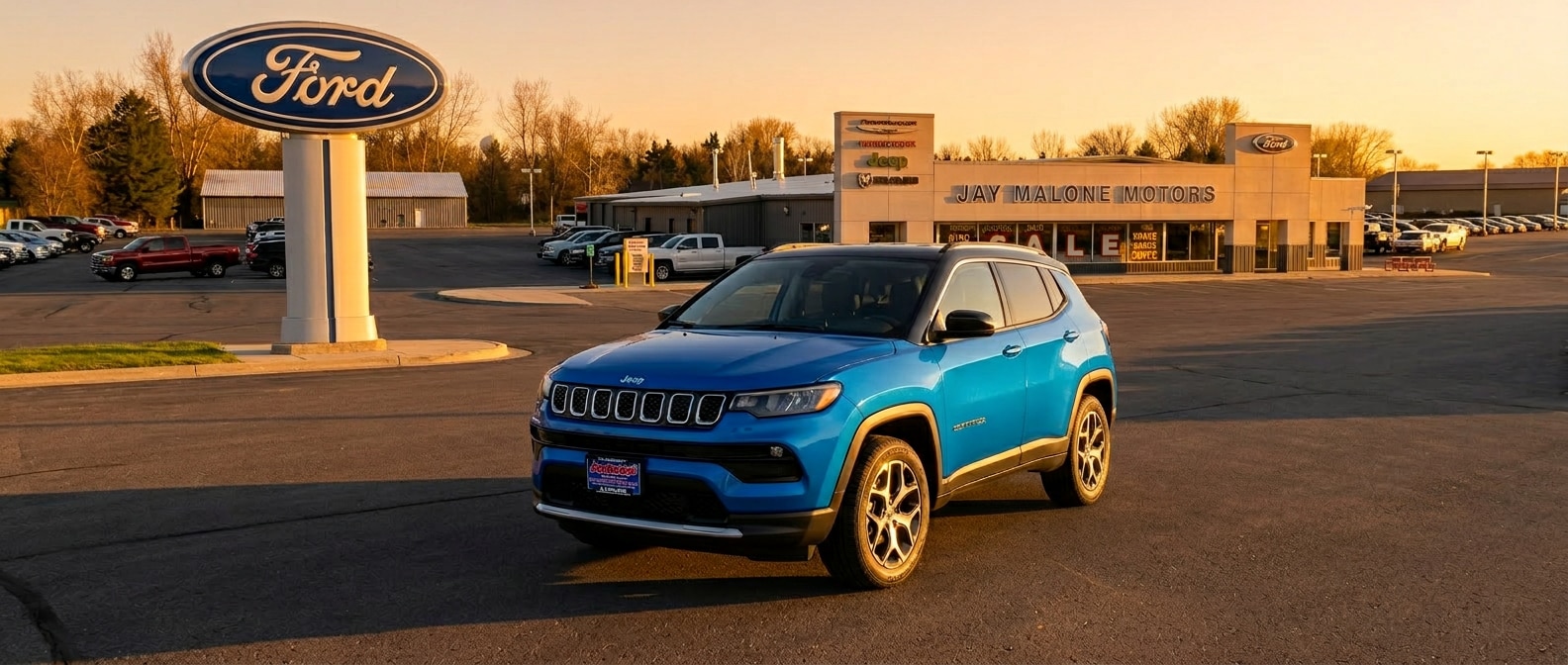
Purchase any new or used vehicle from Jay Malone Motors between August 1–21, 2026 and receive two (2) tickets to the Saturday, August 22, 2026 professional football game in Minneapolis, MN, while supplies last. Limit one ticket pair per vehicle purchased. Tickets awarded at delivery. Not affiliated with, endorsed by, or sponsored by any professional football league or team. Must be 18+. See dealer for details. Jay Malone Motors, 1165 Highway 7 West, Hutchinson, MN · (320) 587-4748.
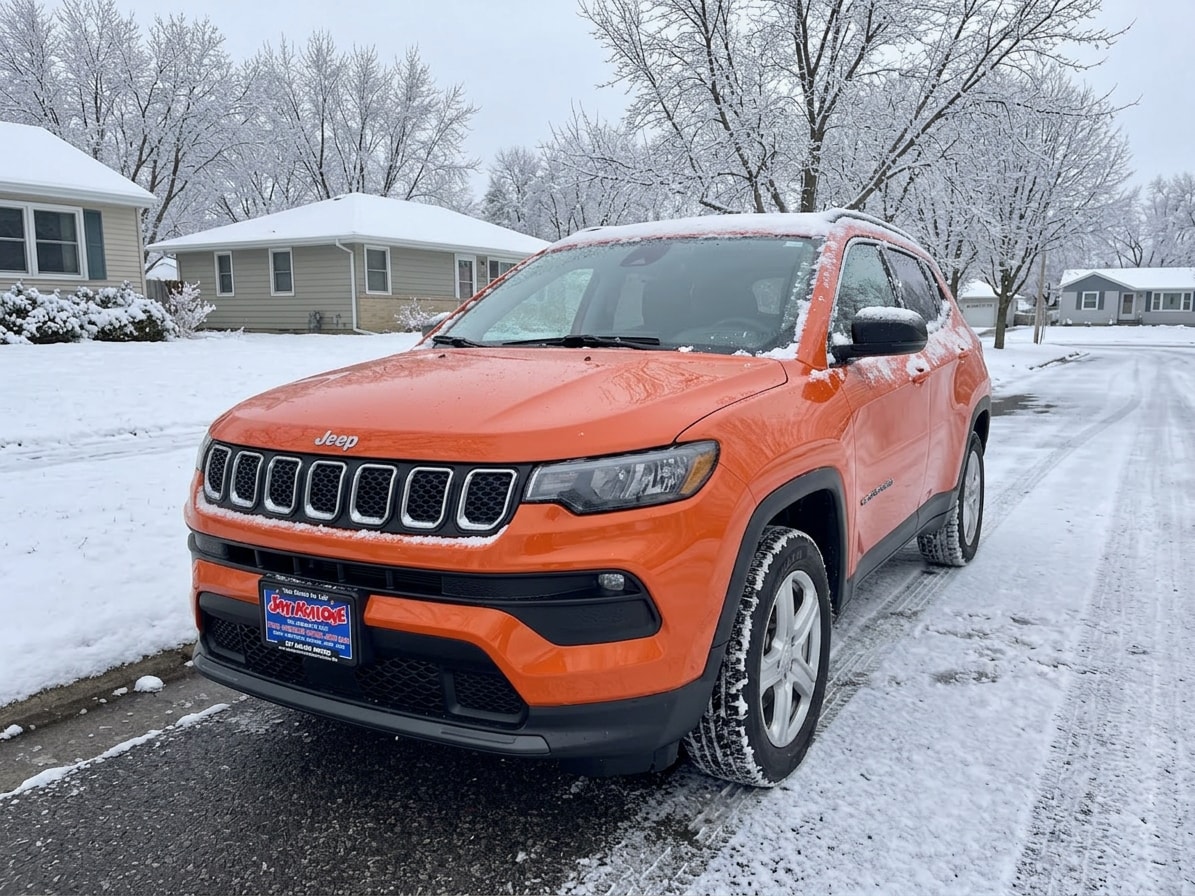
I am Jordan Malone-Forst, Assistant General Manager at Jay Malone Motors in Hutchinson, MN, and if you are shopping the 2026 Jeep Compass Trailhawk, you are looking at the most capable compact SUV in our lineup. The Trailhawk is not a cosmetic package layered on top of a standard Compass — it is a fundamentally different vehicle with hardware specifically engineered for off-road use, trail-capable suspension, and a 4WD system that goes significantly further than what the Latitude and Limited offer.
This blog covers everything that makes the Trailhawk different: the Trail Rated certification, the Active Drive Low 4WD system, the skid plate layout, the suspension tuning, the tires, the angles, and what all of it means for buyers in central Minnesota who want genuine capability without buying a full-size off-road vehicle. For the full buying picture, start with our 2026 Jeep Compass Buyer's Guide. For a full trim comparison, see our trim levels blog.
What Does the Trail Rated Badge Actually Mean?
The Trail Rated badge on the 2026 Compass Trailhawk is not a marketing designation — it is a certification that the vehicle has been tested and proven across five specific off-road performance categories. Every vehicle that earns the badge has to pass standardized testing in all five areas. The five categories are:
1. Traction
The ability to maintain forward progress on loose, slippery, or uneven surfaces. The Trailhawk's Active Drive Low system, Falken all-terrain tires, and Selec-Terrain modes are the primary contributors here.
2. Ground Clearance
The ability to clear obstacles without the undercarriage making contact. The Trailhawk's 8.6-inch ground clearance, raised suspension, and four skid plates contribute to this rating.
3. Maneuverability
The ability to navigate tight off-road situations. The Trailhawk's shorter turning diameter of 35.3 feet (vs. 36.3 feet on the standard Compass) helps it navigate more precisely on trails.
4. Articulation
The ability to maintain tire contact with uneven terrain. The off-road suspension tuning and breakover angle of 23.6 degrees on the Trailhawk supports wheel articulation over uneven surfaces.
5. Water Fording
The ability to drive through standing water without damage. The Trailhawk is rated for 19 inches of water fording depth, compared to 16 inches on the standard Compass 4x4. That extra 3 inches matters when you are crossing a flooded gravel road in spring or a shallow creek crossing on a trail.
The standard Compass with Jeep Active Drive does not carry the Trail Rated badge. It takes the full combination of Active Drive Low, off-road suspension, the four skid plates, the tires, and the certified angles to earn it. The badge on the Trailhawk's front fender means every one of those tests has been passed.
What Is Jeep Active Drive Low and What Does 20:1 Crawl Ratio Mean?
The Jeep Active Drive Low system is exclusive to the Trailhawk and is the most significant capability differentiator between it and every other Compass trim. Here is what it actually does.
Standard Jeep Active Drive (Latitude and Limited) is a full-time 4x4 system with rear-axle disconnect. It automatically manages torque distribution between the front and rear axles and works well for everyday all-weather driving, snow, and light trail use. What it does not have is a low-range setting.
Jeep Active Drive Low adds a low-range setting with a 20:1 crawl ratio. The crawl ratio is the key number. It represents the torque multiplication the drivetrain can deliver to the wheels at very low speeds. A 20:1 crawl ratio means the engine can turn 20 times for every one rotation of the output shaft — producing enormous torque at the wheels while moving at a very slow, controlled speed.
In practical terms, a 20:1 crawl ratio means the Trailhawk can:
Creep over rocks, roots, and uneven terrain at walking pace without the engine lugging or stalling
Maintain precise speed control on steep descents (in combination with Hill Descent Control)
Extract itself from deep mud, sand, or snow by applying maximum torque at minimal wheel speed
Navigate technical trail obstacles where momentum-based approaches would cause damage
For buyers in central Minnesota who are not doing extreme rock crawling but do encounter steep, muddy, or snow-covered terrain on gravel roads, boat ramps, hunting land approaches, or rural property in McLeod County — the low-range system gives the Trailhawk a meaningful capability edge that the Latitude and Limited simply cannot replicate.
What Does Each Selec-Terrain Mode Do on the Trailhawk?
The Trailhawk's Selec-Terrain system offers four modes: Auto, Snow, Sand/Mud, and Rock. The Latitude and Limited only get the first three — Rock mode is Trailhawk-exclusive. Here is what each one actually adjusts.
Auto
The default everyday mode. The system automatically optimizes torque distribution, throttle response, and traction control for normal driving conditions. Best for highway, city driving, and light mixed surfaces. Leave it here for your typical Hutchinson-to-Willmar run.
Snow
Calibrates throttle response for gentler power delivery to reduce wheelspin on ice and packed snow, adjusts transmission shift points for more controlled acceleration, and optimizes stability control for low-traction winter conditions. For McLeod County buyers, this is the mode you engage on icy county roads, slippery parking lots, and snow-covered gravel in January and February.
Sand/Mud
Allows more controlled wheel slip to help the tires dig through loose or deep surfaces. Throttle response is adjusted for better momentum management in sand or mud. Useful for muddy boat ramps, wet fields, and the kind of spring mud conditions central MN buyers encounter regularly on rural roads and approaches.
Rock — Trailhawk Exclusive
Designed for slow-speed technical terrain. Rock mode engages the Active Drive Low system for maximum torque at crawl speeds, reduces throttle sensitivity for precise control, and works in combination with Hill Descent Control to maintain steady speed on steep descents. This is the mode for legitimate off-road trails, rocky approaches, and steep unimproved surfaces where maintaining traction and control at very low speeds is essential. Not available on any other Compass trim.
How Is the Trailhawk Suspension Different?
The Compass Trailhawk uses a purpose-built off-road suspension tune that is distinct from the AWD suspension used on the Latitude and Limited. The off-road suspension is specifically calibrated to work with the Trailhawk's raised ride height and Trail Rated capability requirements — it is not simply the standard suspension with a lift kit added.
The result is a 1-inch increased ride height compared to the standard Compass, which contributes directly to the Trailhawk's 8.6-inch ground clearance (vs. 8.1 inches on Latitude and Limited). That half-inch of additional clearance, combined with the higher approach angle and off-road suspension articulation, is part of what earns the Trail Rated certification.
For everyday driving in Hutchinson and on central MN roads, the off-road suspension calibration provides a slightly firmer, more planted ride feel compared to the AWD suspension on the Limited. It is not harsh — this is still a compact SUV designed for daily use — but it is tuned with trail use in mind, not purely for highway comfort.
What Do the Four Skid Plates Protect?
The Trailhawk is the only Compass with underbody protection. It carries four skid plates covering the most vulnerable components when driving over rocks, stumps, ruts, and rough terrain. The Latitude and Limited have no underbody skid protection in any configuration.
Skid Plate
What It Protects
Why It Matters
Fuel Tank
The fuel tank on the underside of the vehicle
A punctured fuel tank on a trail or gravel road is a serious and expensive problem. This plate prevents contact with rocks and debris.
Transfer Case
The transfer case housing the Active Drive Low system
The transfer case is the heart of the 4WD system. Protecting it from rock strikes preserves the capability the Trailhawk is built around.
Front Suspension
Front suspension components
Front suspension components are vulnerable when traversing rocks and high-centered terrain. Damage here affects steering and handling.
Transmission
The 8-speed automatic transmission
Transmission damage on the trail is a vehicle-ending event. This plate protects one of the most expensive components on the vehicle.
For buyers who stick to gravel roads and light trail use, the skid plates are a confidence and insurance item more than a daily necessity. For buyers who push into more technical terrain, they are genuinely essential. Either way, they add meaningful peace of mind that the Latitude and Limited simply do not offer.
What Are the Falken Wildpeak All-Terrain Tires?
The 2026 Compass Trailhawk comes standard with Falken Wildpeak all-terrain tires in size 215/65R17 — unique to the Trailhawk. The Latitude uses 225/60R17 all-season tires and the Limited uses 225/55R18 all-season tires. The Trailhawk's tire choice is deliberate and specific.
Falken Wildpeak tires are a well-regarded all-terrain tire with a reputation for performing across a wide range of conditions. What the Wildpeak all-terrain design brings to the Trailhawk compared to a standard all-season tire:
More aggressive tread pattern with larger tread blocks for better grip on loose surfaces, mud, and gravel
Reinforced sidewalls for better resistance to punctures and sidewall damage on rocky terrain
Strong winter traction — the Wildpeak A/T is a capable winter tire for snow and ice alongside its off-road performance
Designed to work with the Trailhawk's off-road suspension and Active Drive Low system as a matched capability package
For Minnesota buyers, the Wildpeak all-terrain tire is genuinely well-suited to the mixed conditions our region produces — packed snow and ice in winter, mud and gravel in spring, and dry pavement in summer. It is a tire that performs across all of those conditions better than a standard all-season, while still being comfortable for daily highway driving.
Approach, Departure, and Breakover Angles: Why They Matter
The off-road angles are the numbers that tell you how extreme a terrain feature the vehicle can handle without making contact. The Trailhawk's angles are significantly better than the standard Compass across the board.
Angle
Standard 4x4 (Latitude/Limited)
Trailhawk (Trail Rated)
Approach Angle
16.1 degrees
30.4 degrees
Departure Angle
31.4 degrees
34.0 degrees
Breakover Angle
22.5 degrees
23.6 degrees
Water Fording
16 inches
19 inches
Approach angle is the maximum slope angle the vehicle can drive up to without the front bumper or air dam making contact. The Trailhawk's 30.4-degree approach angle is nearly double the standard Compass's 16.1 degrees. That dramatic difference comes from the Trailhawk's redesigned front fascia, which removes the lower air dam that limits the standard Compass.
Departure angle is the maximum downslope angle the vehicle can drive off of without the rear bumper dragging. The Trailhawk improves on the standard Compass here as well, with 34.0 degrees versus 31.4.
Breakover angle is the maximum ridge or crest the vehicle can pass over without the underside making contact. At 23.6 degrees, the Trailhawk edges out the standard 22.5 degrees — a smaller gap than the approach angle difference, but meaningful on technical terrain.
The approach angle difference is the most practically significant number for most buyers. A 16.1-degree approach angle means the standard Compass will scrape its front air dam on terrain that the Trailhawk clears easily at 30.4 degrees. If you have ever seen a non-Trailhawk Compass struggle on a steep gravel driveway or a rutted field approach and wondered why — this is the number that explains it.
Can the Trailhawk Tow?
Yes — and it is the only Compass trim that can. The Trailer Tow Group is available on the Trailhawk only for $1,575 MSRP. It includes a Class III receiver hitch and a 4-pin wiring harness. Maximum towing capacity when properly equipped is 2,000 lbs.
The Trailer Tow Group is not available on the Latitude or Limited in any configuration. If towing is part of how you plan to use this vehicle, the Trailhawk is your only path.
At 2,000 lbs, the Trailhawk handles personal watercraft, single-axle utility trailers, lightweight cargo trailers, and small equipment trailers — the kind of light towing that is common for buyers in rural McLeod County and surrounding areas who want a compact SUV that can occasionally pull something without needing a full-size truck.
What Does the Trailhawk Actually Handle in Central Minnesota?
I want to be honest with buyers about this because I think it matters. The Compass Trailhawk is genuinely capable — it is Trail Rated, and those certifications represent real testing. But it is a compact SUV, not a Wrangler. Here is a realistic picture of what it handles well in our region.
Gravel Roads and Rural Approaches
The Trailhawk is excellent on gravel roads throughout McLeod County. The all-terrain tires, higher clearance, and off-road suspension handle washboard gravel, loose stone, and rutted farm approaches confidently. This is the most common real-world use case for Trailhawk buyers in our area.
Minnesota Winters
Snow mode, the Wildpeak all-terrain tires, and the Active Drive Low system combine to make the Trailhawk one of the most capable compact SUVs available for Minnesota winter driving. Icy county roads, snow-covered gravel, and winter parking lots are all well within its capability. The wiper de-icer and remote start standard on this trim also make Minnesota winter mornings significantly more manageable.
Muddy Boat Ramps and Spring Conditions
Spring mud season is a real challenge for compact SUVs in central MN. The Trailhawk's Sand/Mud mode, all-terrain tires, and Active Drive Low system handle slippery boat ramps and muddy field approaches significantly better than a standard all-season setup. The full-size spare tire is also meaningful here — getting a flat on a remote gravel road with a tire service kit instead of a real spare is a situation you want to avoid.
Light Trail Use and Hunting Land
For buyers who access hunting land, camping spots, or recreational trails in the region, the Trailhawk handles light to moderate trail conditions confidently. Rock mode, the 20:1 crawl ratio, skid plates, and 30.4-degree approach angle give it capability that a standard AWD crossover cannot match. It is not a vehicle for extreme rock crawling or highly technical off-road trails, but for the kind of light trail access that central MN buyers actually encounter, it is more than capable.
Key Takeaways
The Trail Rated badge requires certification across five categories: traction, ground clearance, maneuverability, articulation, and water fording
Jeep Active Drive Low with a 20:1 crawl ratio is exclusive to the Trailhawk — the Latitude and Limited cannot access this system
Rock mode in Selec-Terrain is Trailhawk-exclusive and requires Active Drive Low to function
Four skid plates protect the fuel tank, transfer case, front suspension, and transmission — none of the other Compass trims have underbody protection
The approach angle difference is dramatic: 30.4 degrees on the Trailhawk vs. 16.1 degrees on the standard Compass
Falken Wildpeak all-terrain tires are purpose-matched to the Trailhawk's off-road suspension and capability system
Towing up to 2,000 lbs is available only on the Trailhawk with the Trailer Tow Group ($1,575) — not available on any other Compass trim
Frequently Asked Questions
Is the Jeep Compass Trailhawk good for off-roading?
Yes — for light to moderate off-road use the Trailhawk is genuinely capable. It carries the Trail Rated badge, which requires passing standardized testing across five capability categories. The Active Drive Low system with a 20:1 crawl ratio, four skid plates, Falken all-terrain tires, 8.6-inch ground clearance, and 30.4-degree approach angle make it significantly more capable than a standard AWD crossover. For extreme rock crawling or highly technical trails, a Wrangler is the right vehicle. For gravel roads, hunting land approaches, muddy boat ramps, and light trails in central MN, the Trailhawk handles it confidently.
What is the difference between Jeep Active Drive and Active Drive Low?
Jeep Active Drive (Latitude and Limited) is a full-time 4x4 system with rear-axle disconnect that automatically manages torque distribution. It is solid for everyday driving, snow, and light trail use but has no low-range capability. Jeep Active Drive Low (Trailhawk only) adds a low-range setting with a 20:1 crawl ratio for maximum torque at very low speeds on demanding terrain. It also enables Rock mode in Selec-Terrain and works with Hill Descent Control. Active Drive Low is the system that earns the Trail Rated badge.
Does the Compass Trailhawk have a full-size spare tire?
Yes. The Trailhawk comes standard with a full-size spare tire. The Compass Latitude and Limited come with a tire service kit instead of a full-size spare. For buyers who use the Trailhawk on gravel roads or off-pavement where a flat is more likely, having a full-size spare rather than a service kit is a meaningful practical difference.
Can I add skid plates or a hitch to a Compass Latitude or Limited?
The Trailer Tow Group (Class III hitch + 4-pin wiring) is only available on the Trailhawk — it is not offered on the Latitude or Limited in any configuration. The four skid plates on the Trailhawk are factory-installed components of the Trail Rated package and are not available as add-ons for the Latitude or Limited. If underbody protection and towing capability are important to you, the Trailhawk is the trim you need.
Is the Trailhawk comfortable for daily driving?
Yes. Despite its off-road focus, the Trailhawk is a practical daily driver. It comes standard with the 10.1-inch Uconnect 5 touchscreen, 10.25-inch digital cluster, adaptive cruise control, power liftgate with foot-activation, dual-zone climate, heated front seats, heated steering wheel, remote start, wiper de-icer, and rain-sensing wipers. The Falken Wildpeak all-terrain tires are slightly noisier on dry pavement than the all-season tires on the Latitude and Limited, but they are engineered for road comfort alongside their off-road performance. The Trailhawk does not ask you to sacrifice daily convenience to get trail capability.
Want to see the Trailhawk's capability in person? Come in to Jay Malone Motors in Hutchinson and I will walk you through what every one of these systems actually does. We serve buyers from across central Minnesota and we are happy to take the time to match you to the right vehicle.
I'm Jordan Malone-Forst, Assistant General Manager at Jay Malone Motors in Hutchinson, MN. Our family has been selling and servicing vehicles in this community since 2005. I serve as President of the Hutchinson Ambassadors and sit on the Board of Directors for the Hutchinson Area Chamber of Commerce & Tourism. If you have questions about the Compass Trailhawk or want to talk through whether it is the right fit for you, reach out — I would love to help.